The Authority Gap in Senior Leadership
Victoria Canham • 4 March 2026 • 4 min read
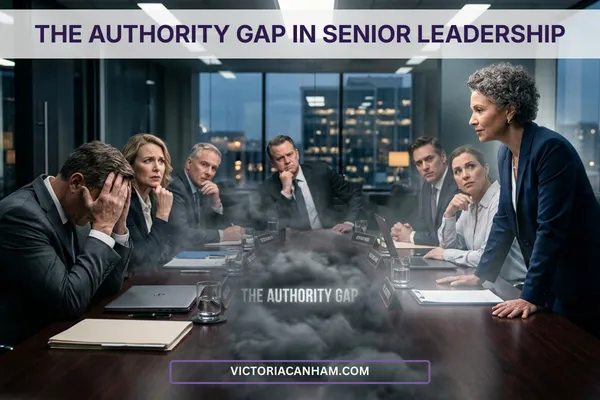
Many senior leaders have the title. Far fewer are actually leading.
Most executive teams have a problem they are not addressing.
On paper the leadership is strong, with serious titles. The people in the room are experienced and well paid. One might even suggest that from the outside, everything appears solid.
Then pressure arrives, and the cracks show.
Decisions drag on longer than they should, issues circle the table for weeks, the most difficult conversations somehow never quite happen, then someone senior behaves badly and nobody deals with it properly.
Everyone notices, but no one speaks up or calls it out.
This is the authority gap.
The space between the senior role someone holds and their ability to actually lead when it matters.
Many organisations operate like this for years.
Titles are given. Authority is earned.
A promotion puts someone in the role, but authority comes from how they behave once they are there.
Many leaders think employees don’t notice, but people at all levels watch closely. They notice whether a leader deals with problems directly or avoids friction. They notice whether decisions move forward or drift around the organisation, gathering opinions. They notice who really influences the room.
Authority builds through those moments.
Many executives reach senior roles because they were exceptional performers earlier in their careers; delivering results, staying reliable under pressure, understanding the business and making things happen. All of which are strengths that matter.
They are not the same as leadership.
Senior leadership asks for something harder: judgment under uncertainty, the ability to hold disagreement between intelligent people, and the willingness to make calls that will not please everyone in the room.
That shift catches more leaders out than organisations like to admit.
The moment a team senses the gap
Teams do not need long to work out whether a leader truly holds the role.
It shows up in patterns.
A problematic colleague remains untouched because confronting them would be uncomfortable. Strategy shifts depending on who had the strongest view in the last meeting. Feedback is softened to keep relationships smooth.
The environment adjusts quickly.
People stop pushing as hard. They still contribute, but with less belief that the discussion will lead anywhere decisive. The sharper conversations happen in corridors afterwards.
From the outside, the company continues operating. Targets might still be hit. Yet the quality of leadership has weakened.
Inside the organisation, people can feel it.
Senior leaders feel it too
Many executives know when something is off, even if they cannot immediately explain it.
There is a particular weight that comes with senior leadership. During the earlier stages of a career, you are rewarded for solving problems and being collaborative. At the top of an organisation, the job changes.
You carry decisions that affect thousands of people. Alignment is never perfect. Someone capable and intelligent will disagree with you most weeks.
That is normal.
The difficulty begins when leaders try to remove that tension instead of holding it.
Decisions get delayed. Issues get reframed. Consensus becomes more important than clarity.
In the short term, it feels safer; over time, it weakens leadership.
What happens when authority is missing
When senior leaders do not fully occupy their authority, something else fills the space.
Politics grows, and informal influence becomes stronger than formal roles. People begin working around the leadership team rather than through it.
Energy shifts away from the work itself and into interpretation. Who really decides things here? Which opinion actually carries weight?
Strong organisations lose momentum this way.
Good people become tired of navigating uncertainty that should not exist at the top of the business.
CEOs often describe a sense of isolation during this phase, because they can’t always rely on the leadership group around them to hold difficult ground with them.
What real authority actually looks like
The leaders who hold authority well are usually the calmest people in the room. They deal with issues directly. They name tension early instead of letting it harden into politics. When a decision is required, they make it and stay open to adjusting if new information appears.
People trust leaders like this because they are clear.
Clarity reduces anxiety inside organisations. When people know where things stand, they can focus on the work rather than guessing what is really happening.
That stability spreads through the system faster than any culture initiative.
Why organisations avoid this conversation
The authority gap is uncomfortable to highlight because these are senior people with long careers and strong reputations (not to mention healthy egos). Challenging their leadership capacity can feel confrontational or risky.
So organisations reach for safer responses, leadership programmes, culture workshops and engagement surveys. Some help, some of the time, but many avoid the real issue sitting at the top of the system.
Leadership maturity.
The willingness of senior leaders to look honestly at how they show up in the role and where they hesitate when the pressure rises.
The leaders who close the gap
The strongest leaders I work with share one trait.
They are willing to look at themselves without the protection that usually comes with seniority.
They notice when they are avoiding a conversation. They recognise when approval is shaping a decision. They address tension inside the leadership team rather than hoping it will resolve itself.
It takes courage, the professional kind.
By the time someone reaches a senior role, capability is rarely the real constraint.
The real question is whether they are prepared to fully step into the authority the role requires.
That means making decisions that will frustrate some people, holding firm when the room pushes back, and allowing disagreement without losing direction.
When leaders do that, organisations change quickly.
Meetings become more honest. Decisions move faster. People trust the leadership again.
Nothing magical has to happen; the leaders simply need to start leading.
♦️ Hi, I'm Victoria Canham. I work with senior leaders, executives, founders and organisations when performance, pressure and people dynamics reach a point where the usual tools stop working.
My work sits at the intersection of leadership psychology, organisational performance and culture reality. I help executive teams navigate strained relationships, cultural brittleness, emotional fatigue, and the quiet erosion of trust that most businesses prefer not to acknowledge.
This isn't "feel-good" leadership development. It is measured, commercially grounded support that builds capability, deepens emotional resilience, and helps leaders operate with greater clarity, strength and humanity.
♦️ How I support organisations and senior leaders:
Executive Advisory
I work alongside CEOs and senior leaders as a trusted, discreet thinking partner. We deal with the real conversations, the emotional load of leadership, decision-making under pressure, and the personal dynamics that affect performance and culture.
Leadership Facilitation & Development
I design high-level development that respects intelligence, emotional reality and commercial context. These programmes help leaders communicate better, hold difficult conversations safely, and lead in a way that is firm, clear and credible.
Culture, Performance & Retention Support
I help organisations stabilise culture and strengthen psychological safety in ways that shift behaviour and engagement — not just look impressive on a slide deck.
If your leadership team is under strain, if relationships feel tense, or if the culture is becoming brittle, it may be time for a different conversation.
Book a confidential call to talk openly, think clearly and work out what your organisation really needs. No theatrics. No fluffy platitudes. Just honest, expert partnership.
Follow me on LinkedIn for human, psychologically intelligent leadership that actually works in the real world.

Comment On This Article
Recommended Reading
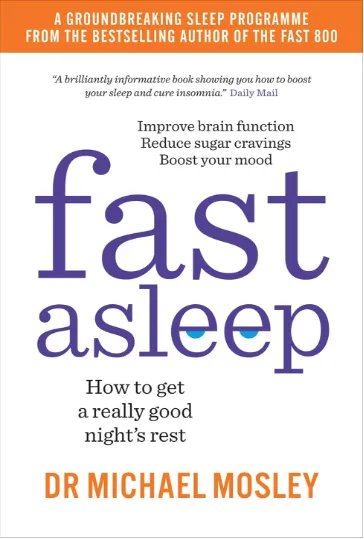
Fast Asleep: How to get a really good night's rest by Dr Michael Mosley
A good night's sleep is essential for a healthy brain and body. So why do so many of us struggle to sleep well? In Fast Asleep, Dr Michael Mosley explains what happens when we sleep, what triggers common sleep problems and why standard advice rarely works.
Prone to insomnia, he has taken part in numerous sleep experiments and tested every remedy going. The result is a radical, four-week programme, based on the latest science, designed to help you re-establish a healthy sleep pattern in record time.
With plenty of surprising recommendations - including tips for teenagers, people working night shifts and those prone to jet lag - plus recipes which will boost your deep sleep by improving your gut microbiome, Fast Asleep provides the tools you need to sleep better, reduce stress and feel happier.
We’re not just about overcoming obstacles, we’re about transforming lives.
Book Recommendation
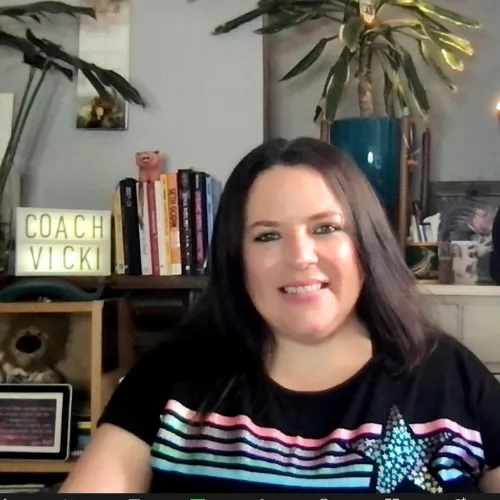
Victoria Canham - Performance and People Strategic Partner
Victoria Canham is a senior Performance and People Strategic Partner, working with executive leaders and organisations when performance, culture, relationships and emotional pressure collide. She is an ICF-accredited Professional Coach and the founder of Victoria Canham Consultancy, a specialist practice focused on strengthening leadership capability, resilience, psychological safety and organisational performance in the real world, not just on paper.
With a background in behavioural insight, leadership psychology and large-scale change, Victoria supports senior leaders navigating strained relationships, brittle cultures, team fatigue and high-pressure decision-making. Her work helps leadership teams stabilise, communicate more effectively, rebuild trust and operate with greater clarity, humanity and authority.
She partners with CEOs, senior leaders and HR to address what is actually happening beneath performance headlines, guiding organisations through the conversations and capability shifts they cannot safely or effectively manage internally. The result is stronger leadership, healthier cultures, more resilient teams, and organisations better equipped to perform sustainably.
Follow us on social media


💸 Your people don’t leave for money. 💣 They leave for culture. 🔧 I fix that. 🏆 Retention & performance strategy that works.
Book a ☎️ | Fix the Leaks


© Copyright 2026 Victoria Canham Coaching | Website built by Me on FEA Create (aff.)
Performance Coaching Reading, London, Berkshire, Oxford | St George's Road, Reading, Berkshire, United Kingdom, RG30 2RL | +44 7377 527 529 | [email protected] Open Monday to Friday 9 am until 5 pm