The Gap Between the Culture Deck and Monday Mornings
Victoria Canham • 13 May 2026 • 4 min read
May Leadership Series · Part 2 of 4
Organisations have invested heavily in culture. Engagement is still falling. The piece of the conversation that gets the least attention is the state of the people at the top.
Most organisations have a culture deck. It describes the values, the behaviours, the kind of place this is and the kind of people who belong here. It was probably workshopped at vast expense and written carefully with a senior leader and an HR offsite. Senior leaders signed off on it and, in many cases, genuinely believe in it.
Then Monday morning arrives.
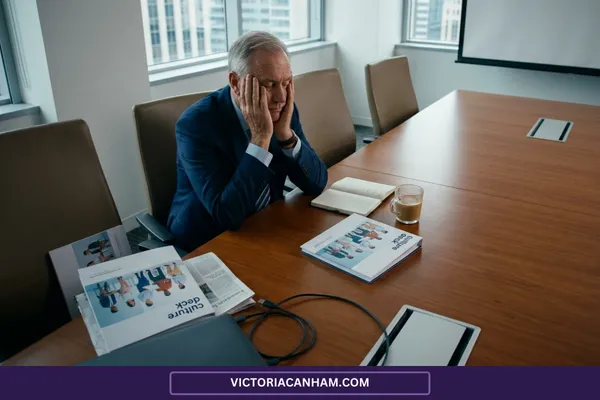
The meeting runs over and the agenda item about team development gets parked again. The senior leader who is running on four hours of sleep with a set of quarterly results whose numbers are not where they need to be, sits at the head of the table, and everyone in the meeting reads them accurately. The open-door policy exists because the door is technically open, but the leader’s actual availability and their bandwidth to hear difficult things, and their capacity to be present rather than distracted, are entirely another matter.
The team knows; they always know.
Why engagement surveys keep returning the same results
Employee engagement fell to a ten-year low in 2024 across the business landscape. The reasons have been largely structural: better benefits, more flexible working, clearer career pathways, updated values frameworks, and investment in manager training.
These are reasonable responses to a real problem. They address the conditions of work. What they address less directly is the experience of being led.
The experience of being led is not primarily shaped by policy. It is shaped by the person doing the leading and their actual state on any given day. How much genuine attention they bring to the people around them. Whether they are leading from a place of belief in the direction or one of private exhaustion. Whether the optimism they express in all-hands meetings is something they feel or something they have decided to project because the alternative is too costly.
Teams are sophisticated readers of the leaders above them. They have to be. A leader’s mood, energy, and genuine level of engagement with the work affects the team’s daily reality in concrete ways — what gets prioritised, who gets heard, how decisions are made, and whether it is safe to raise a problem. People learn to read these signals early, and they read them continuously.
What leaders are carrying with them right now
This is the part of the engagement conversation that requires the most honesty, and receives the least.
A significant number of senior leaders are currently operating under sustained strain. The economic uncertainty is real. The pace of change — technological, regulatory, market-level — has not let up. The expectations on leaders have expanded, while the resources, the clarity, and, in many cases, the psychological safety to admit difficulty have not kept pace.
Leaders bring all of that into every meeting, every conversation, every decision. The strain shows in shortened attention spans, in a reduced tolerance for ambiguity, and in the quality of listening that is available when someone needs to raise something difficult. It shows in how risk is assessed, and in how much patience exists for the slower, messier work of developing people rather than simply directing them.
None of this is a character failing. It is a consequence of sustained demand without adequate acknowledgement of what that demand costs.
The consequence for teams, however, is real regardless of its cause.
The culture the team is actually living in
Culture is not the values on the wall. It is the accumulated experience of what it is like to work here, shaped daily by the behaviour of the people with the most authority.
When a senior leader is stretched thin, the culture shifts in specific ways. Psychological safety erodes because people sense that the leader’s capacity to handle difficulty is reduced, and they adjust accordingly. Development conversations become transactional because there is no bandwidth for the exploratory kind. The team’s horizon shortens to match the leader’s: survival and delivery, rather than growth and possibility.
Over time, these adjustments harden into norms. The team that stopped raising strategic challenges because the leader was too stretched to engage with them is now a team that does not raise strategic challenges. The adjustment has become the culture.
The question the engagement data is actually asking
When engagement falls, organisations ask what they need to change about the environment. The more direct question is: what is it like to be led by the senior leadership of this organisation right now, in this specific quarter, given everything those leaders are responsible for?
That question is uncomfortable because it locates the issue closer to the top than most organisations want to look. It is also more useful because it points to a different set of interventions.
If the senior team is depleted, the first priority is the senior team. Their responsibilities, what they need, and what would need to change for them to lead with the quality of presence the culture deck describes. The team’s experience follows directly from that. It does not precede it.
What this requires from senior leaders directly
Senior leaders need an honest account of their own current state, not for the purposes of disclosure or performance, but as a precondition for accurate diagnosis.
If you are leading a team whose engagement is low, the starting question is not what the team needs to change. It is what your leadership is currently providing and what it is not. What you are genuinely able to offer right now, and where the gap is between that and what the role requires. Do you have a suitable outlet available to the leaders so that they can talk honestly?
The culture deck describes what the organisation aspires to be. Your daily behaviour, in the actual conditions of this actual quarter, is what it is.
Those two things can be brought closer together. The first step is knowing the distance between them fully and accurately.
This is Part 2 of a four-part May series: Leading From Where You Actually Are.
Next: Who Actually Benefits When You Keep Going.
♦️ Hi, I'm Victoria Canham. I work with senior leaders, executives, founders and organisations when performance, pressure and people dynamics reach a point where the usual tools stop working.
My work sits at the intersection of leadership psychology, organisational performance and culture reality. I help executive teams navigate strained relationships, cultural brittleness, emotional fatigue, and the quiet erosion of trust that most businesses prefer not to acknowledge.
This isn't "feel-good" leadership development. It is measured, commercially grounded support that builds capability, deepens emotional resilience, and helps leaders operate with greater clarity, strength and humanity.
♦️ How I support organisations and senior leaders:
Executive Advisory
I work alongside CEOs and senior leaders as a trusted, discreet thinking partner. We deal with the real conversations, the emotional load of leadership, decision-making under pressure, and the personal dynamics that affect performance and culture.
Leadership Facilitation & Development
I design high-level development that respects intelligence, emotional reality and commercial context. These programmes help leaders communicate better, hold difficult conversations safely, and lead in a way that is firm, clear and credible.
Culture, Performance & Retention Support
I help organisations stabilise culture and strengthen psychological safety in ways that shift behaviour and engagement — not just look impressive on a slide deck.
If your leadership team is under strain, if relationships feel tense, or if the culture is becoming brittle, it may be time for a different conversation.
Book a confidential call to talk openly, think clearly and work out what your organisation really needs. No theatrics. No fluffy platitudes. Just honest, expert partnership.
Follow me on LinkedIn for human, psychologically intelligent leadership that actually works in the real world.

Comment On This Article
Recommended Reading
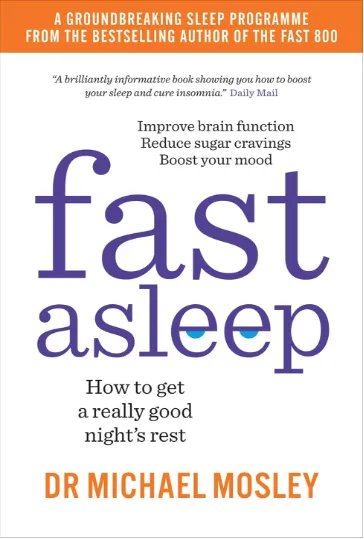
Fast Asleep: How to get a really good night's rest by Dr Michael Mosley
A good night's sleep is essential for a healthy brain and body. So why do so many of us struggle to sleep well? In Fast Asleep, Dr Michael Mosley explains what happens when we sleep, what triggers common sleep problems and why standard advice rarely works.
Prone to insomnia, he has taken part in numerous sleep experiments and tested every remedy going. The result is a radical, four-week programme, based on the latest science, designed to help you re-establish a healthy sleep pattern in record time.
With plenty of surprising recommendations - including tips for teenagers, people working night shifts and those prone to jet lag - plus recipes which will boost your deep sleep by improving your gut microbiome, Fast Asleep provides the tools you need to sleep better, reduce stress and feel happier.
We’re not just about overcoming obstacles, we’re about transforming lives.
Book Recommendation
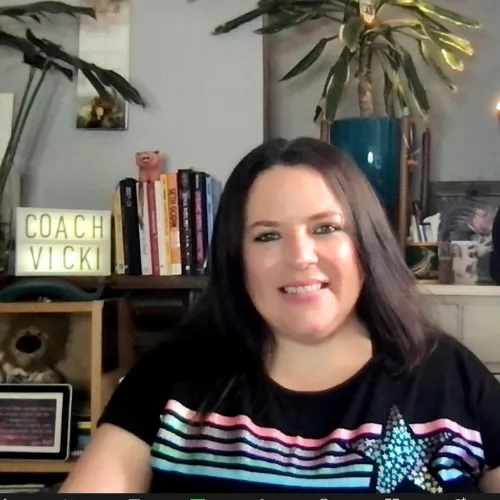
Victoria Canham - Performance and People Strategic Consultant
Victoria Canham works with executive leaders and organisations when performance, culture and emotional pressure collide.
She is a Change Leader with over 25 years of experience, an ICF-accredited Professional Coach and founder of Victoria Canham Consultancy. Her practice focuses on strengthening leadership capability and organisational performance in the real world, not just on paper.
With twenty-five years in talent development, behavioural insight and large-scale change, she supports senior leaders navigating strained relationships, brittle cultures and high-pressure decision-making. Her work helps leadership teams stabilise, rebuild trust and operate with greater clarity and authority.
She is brought in when organisations cannot safely hold difficult conversations internally—when executive teams have stopped saying what needs saying, when founders need to step back, when high-performing individuals are costing more than they deliver. She creates the conditions where those conversations can actually happen, and where organisations can move forward from them.
The result is leadership that functions under pressure, cultures that hold up in practice, and teams equipped to perform sustainably.
Follow us on social media


💸 Your people don’t leave for money. 💣 They leave for culture. 🔧 I fix that. 🏆 Retention & performance strategy that works.
Book a ☎️ | Fix the Leaks


© Copyright 2026 Victoria Canham Coaching | Website built by Me on FEA Create (aff.)
Performance Coaching Reading, London, Berkshire, Oxford | St George's Road, Reading, Berkshire, United Kingdom, RG30 2RL | +44 7377 527 529 | [email protected] Open Monday to Friday 9 am until 5 pm