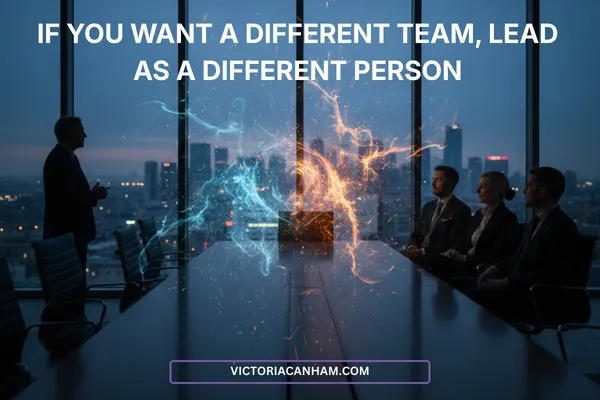
If You Want a Different Team, Lead as a Different Person
Victoria Canham • 18 February 2026 • 5 min read
“I need a stronger team.”
By the time a senior leader says this to me, they are usually tired. Tired of repeating instructions, carrying the thinking, and tired of feeling like the only adult in the room.
Sometimes their diagnosis is correct, because capability certainly does matter.
However, at this level, the team you have is rarely separate from the leader you are.
Your Leadership Is a Climate
You do not just set direction; you also have to set the climate.
The climate is made up of how you respond when challenged, how you handle delay or error, how you behave when you are under threat, and how tightly you grip when outcomes feel exposed.
Over time, people naturally organise themselves around that.
If you are sharp when stressed, they will become cautious.
If you move the goalposts, they will become political.
If you step in too quickly, they will stop owning.
If you avoid tension, difficult issues will go underground.
These adaptations simply happen, organically.
Months later, you are sitting in a room wondering why your team lacks initiative, candour or backbone.
Why Leaders Resist This Conversation
Senior leaders are not naïve; they know they influence culture, but they resist the idea that their micro-behaviours under pressure are shaping outcomes more than their strategy decks.
It is easier to restructure than to self-regulate, to recruit than to reflect, and easier to adjust incentives than to examine your tone on a bad day.
Structural change feels powerful, while personal change feels exposing.
This is why so many leaders cycle teams - different company, different sector, same complaints.
At some point, pattern recognition becomes unavoidable. It has to.
The Team Is Not the Only Variable
If you consistently experience:
⏺️ Lack of ownership.
⏺️ Reluctance to challenge you.
⏺️ Over-dependence on your approval.
⏺️ Weak accountability between peers.
Then it is worth asking a different question.
What is it like to work for you when the stakes are high?
On a pressured day when the proverbial is hitting the fan left, right and centre, when the sky truly feels like it’s falling.
Do you truly tolerate dissent?
Or does your face tighten before your words stay calm?
Do you delegate authority?
Or do you delegate tasks while quietly retaining control?
Do you say you want strategic thinking?
Or do you override decisions the moment risk appears?
Teams are exquisitely attuned to these inconsistencies. They adapt in order to survive and succeed within your behavioural range.
This Is Agency, Not Blame
You are not responsible for other adults’ character.
You are responsible for the environment your character creates.
If you want more accountability, examine where you soften standards to avoid discomfort.
If you want more challenge, examine how you react when your authority is tested.
If you want more ownership, examine how often you rescue before discomfort has done its work.
This is precision.
Leadership at this level is less about what you demand and more about what you model when it costs you something.
The Identity Shift
Many high-performing leaders built their careers on being indispensable.
The sharpest thinker.
The safest pair of hands.
The one who catches what others miss.
That identity creates success, but it also creates gravity.
If you are always the smartest voice, others defer to you.
If you always correct others, they hesitate.
If you always decide, others wait.
To build a stronger team, you may need to relinquish being the hero.
That can feel like loss, which is where leadership maturity stops being theoretical.
Changing your team may require changing the version of yourself you have relied on for years, and changing your reflexive actions.
From Demanding to Becoming
Most leaders want their team to evolve without evolving themselves.
They want more candour without becoming less defensive, more ownership without becoming less controlling, more strategic thinking without becoming less reactive to risk.
But behaviour cascades.
When you tolerate silence long enough for discomfort to surface, the room changes.
When you respond to a challenge with curiosity rather than subtle punishment, the risk calculus shifts.
When you allow a decision to stand without hovering, capability grows.
None of this is dramatic; it is disciplined restraint, and it requires range.
The Reality
If you want a fundamentally different team, you may need to become a slightly different person in the room.
More self-aware, more regulated and more deliberate about the impact of your presence.
You can hire differently, restructure, or reset targets, but if your leadership patterns remain untouched, the system will reorganise around them again.
The Invitation
Before you diagnose your team, study yourself.
On your most pressured day, what do people experience?
Tension?
Impatience?
Withdrawal?
Control?
Or steadiness?
Clarity?
Room to think?
Responsibility as a leader at this level is not about carrying everyone else, but accepting that your presence is never neutral.
If you want a different team, lead as a different person.
♦️ Hi, I'm Vicki. I work with senior leaders and organisations when performance, pressure and people dynamics reach a point where the usual tools stop working.
My work sits at the intersection of leadership psychology, organisational performance and culture reality. I help executive teams navigate strained relationships, cultural brittleness, emotional fatigue, and the quiet erosion of trust that most businesses prefer not to acknowledge.
This isn't "feel-good" leadership development. It is measured, commercially grounded support that builds capability, deepens emotional resilience, and helps leaders operate with greater clarity, strength and humanity.
♦️ How I support organisations and senior leaders:
Executive Advisory
I work alongside CEOs and senior leaders as a trusted, discreet thinking partner. We deal with the real conversations, the emotional load of leadership, decision-making under pressure, and the personal dynamics that affect performance and culture.
Leadership Facilitation & Development
I design high-level development that respects intelligence, emotional reality and commercial context. These programmes help leaders communicate better, hold difficult conversations safely, and lead in a way that is firm, clear and credible.
Culture, Performance & Retention Support
I help organisations stabilise culture and strengthen psychological safety in ways that shift behaviour and engagement — not just look impressive on a slide deck.
If your leadership team is under strain, if relationships feel tense, or if the culture is becoming brittle, it may be time for a different conversation.
Book a confidential call to talk openly, think clearly and work out what your organisation really needs. No theatrics. No fluffy platitudes. Just honest, expert partnership.
Follow me on LinkedIn for human, psychologically intelligent leadership that actually works in the real world.


Comment On This Article
Recommended Reading
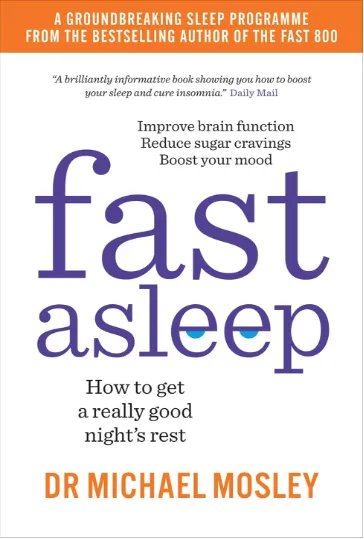
Fast Asleep: How to get a really good night's rest by Dr Michael Mosley
A good night's sleep is essential for a healthy brain and body. So why do so many of us struggle to sleep well? In Fast Asleep, Dr Michael Mosley explains what happens when we sleep, what triggers common sleep problems and why standard advice rarely works.
Prone to insomnia, he has taken part in numerous sleep experiments and tested every remedy going. The result is a radical, four-week programme, based on the latest science, designed to help you re-establish a healthy sleep pattern in record time.
With plenty of surprising recommendations - including tips for teenagers, people working night shifts and those prone to jet lag - plus recipes which will boost your deep sleep by improving your gut microbiome, Fast Asleep provides the tools you need to sleep better, reduce stress and feel happier.
We’re not just about overcoming obstacles, we’re about transforming lives.
Book Recommendation
Victoria Canham - Performance and People Strategic Partner
Victoria Canham is a senior Performance and People Strategic Partner, working with executive leaders and organisations when performance, culture, relationships and emotional pressure collide. She is an ICF-accredited Professional Coach and the founder of Victoria Canham Consultancy, a specialist practice focused on strengthening leadership capability, resilience, psychological safety and organisational performance in the real world, not just on paper.
With a background in behavioural insight, leadership psychology and large-scale change, Victoria supports senior leaders navigating strained relationships, brittle cultures, team fatigue and high-pressure decision-making. Her work helps leadership teams stabilise, communicate more effectively, rebuild trust and operate with greater clarity, humanity and authority.
She partners with CEOs, senior leaders and HR to address what is actually happening beneath performance headlines, guiding organisations through the conversations and capability shifts they cannot safely or effectively manage internally. The result is stronger leadership, healthier cultures, more resilient teams, and organisations better equipped to perform sustainably.
Hang out with us on social media


SOCIAL FEED
💸 Your people don’t leave for money. 💣 They leave for culture. 🔧 I fix that. 🏆 Retention & performance strategy that works.
Book a ☎️ | Fix the Leaks


© Copyright 2026 Victoria Canham Coaching | Website built by Me on FEA Create (aff.)
Performance Coaching Reading, London, Berkshire, Oxford | St George's Road, Reading, Berkshire, United Kingdom, RG30 2RL | +44 7377 527 529 | [email protected] Open Monday to Friday 9 am until 5 pm