
The Leadership Tax You Pay for Outsourcing Responsibility
Victoria Canham • 4 February 2026 • 5 min read
Senior leadership is sustained exposure to pressure. Not the occasional spike, but the slow, grinding kind that accumulates: complex decisions with imperfect data, relational strain that never fully resolves, the emotional weight of consequence, and the reality that your inner state leaks into the system whether you intend it or not.
Most leaders know, intellectually, that they are the common denominator in their impact. They've heard the feedback. They can recite the insight with conviction: "If it keeps happening around me, I'm probably part of it."
And yet.
The same leader who accepts this principle in abstract will, in the moment, attribute a failed relationship to the other person's rigidity. They will explain a team's disengagement as a culture problem. They will frame their own reactivity as a reasonable response to unreasonable circumstances. The intellectual acceptance of responsibility becomes a kind of performance—acknowledged in principle, deferred in practice.
This deferral has a cost. It shows up as friction that repeats across teams, tenures, and transitions. It appears in cultures that mysteriously reflect the leader's own unexamined patterns: the conflict-avoidant CEO who wonders why no one speaks up, the founder who complains about bureaucracy while personally gate-keeping every decision, the executive who laments weak accountability while modelling chronic last-minute pivots. The system becomes a mirror, and the leader, standing in front of it, blames the reflection.
What makes this particularly corrosive is not the failure to change; change is legitimately difficult, but the quiet act of outsourcing responsibility for it. To context. To other people. To "how things are right now." To some future version of the organisation where the conditions will finally be right. The leader remains trapped in patterns they privately dislike but publicly justify, and the justification itself becomes the trap.
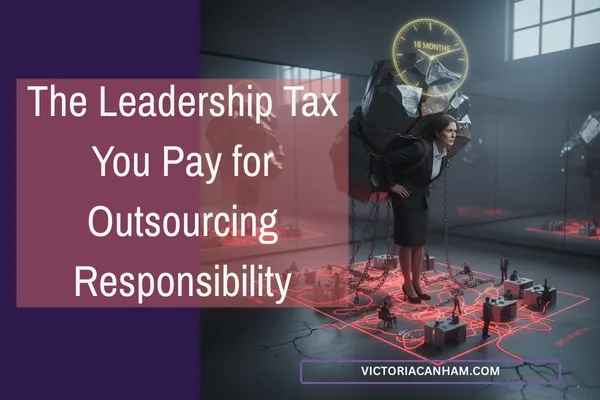
It costs roughly 18 months of culture change effort when a senior leader finally departs, having never addressed what they brought to every room.
The Anatomy of Deferral
Consider the leader who, when challenged on their tone in a tense meeting, responds: "This is just how I am under pressure." It sounds like self-awareness. It might even be delivered with a rueful smile, a gesture toward fallibility. But it is not an acknowledgement of responsibility; it is a pre-emptive closing of the door to change. The subtext is clear: the pressure is the problem, not my response to it. The circumstances are unreasonable; therefore, my behaviour is understandable. And because it is understandable, it does not need to change.
The outsourcing: My wiring is fixed; circumstances must adapt.
Or take the founder who attributes team disengagement to "the culture we've built" without examining their own role in creating it. They speak about trust as though it is a resource that depleted itself, rather than something eroded through repeated interactions, interactions in which they brought impatience, inconsistency, or emotional reactivity that others learned to manage by withdrawing. The culture is not some external force that descended on the organisation. It is the accumulated shape of how people have learned to be around the leader. To blame culture is to outsource responsibility for the relational conditions the leader helped establish.
The outsourcing: The system I created is now independent of me.
Then there is the executive who waits for structural change, a new organisational design, a better team composition, and clearer governance before addressing their own patterns of avoidance. They are eloquent about what needs to shift externally. They are silent, or evasive, about what needs to shift internally. The structure becomes a reason not to act, a placeholder for the difficulty they are unwilling to face in themselves. And so they wait. The structure changes. The patterns persist.
The outsourcing: External conditions must change before I can.
Responsibility as Discipline, Not Morality
Personal responsibility in leadership is not a moral category. It is not about being a better person, cultivating virtue, or performing contrition when things go wrong. It is a discipline—an adult, sober stance that says: I am responsible for the inner and relational conditions I bring to my role, and those conditions shape everything that follows.
This is not blame. Blame is about fault, about judgment, about who is wrong. Responsibility is about agency. It is the recognition that regardless of what you inherited—your temperament, your history, the circumstances you did not choose—you are accountable for how those forces show up in the room. How they shape your tone. How they inform your decisions. How they land on the people around you.
Leaders do not choose all their conditioning. They do not choose the family system they grew up in, the early experiences that shaped their nervous system, the habits of mind they developed to survive earlier chapters of life. But they are responsible for what that conditioning produces now. They are responsible for noticing when their defensiveness shuts down a conversation, when their impatience accelerates bad decisions, when their need for control suffocates initiative in others.
The distinction is critical: understanding why you are the way you are is valuable. It can create compassion for yourself. It can explain the logic of your reactions. But understanding is not a substitute for change. Too often, insight becomes a kind of alibi. "I react this way because of Y." True. And also: you still react this way. The people around you still experience the impact. The pattern still repeats. Understanding the origin of a pattern does not discharge your responsibility for what it produces.
Range, Not Reinvention
The good news, if you can call it that, is about increasing range. Range is the capacity to access more than one response under pressure. It is the ability to pause between stimulus and reaction, to notice what is happening inside you before it becomes the only thing happening in the room.
To notice your own defensiveness rising and choose not to let it dictate the next sentence. To interrupt a habitual response, the sharp comment, the dismissive gesture, the retreat into control, and do something different, even incrementally.
Range allows you to lead without exporting your emotional load onto the system.
This is the hard, unglamorous work of becoming less reactive, less defended, more capable of holding complexity without collapsing into simplicity. It is what makes sustained performance possible without corroding trust, burning out relationships, or consuming your own health as fuel.
The Cost of Waiting
Some leaders defer responsibility because they are waiting ,for more bandwidth, for things to stabilise, for the crisis to pass. They tell themselves: "When things calm down, I'll address this." But things do not calm down. Not at this level. Not in roles of sustained complexity and pressure. Waiting for the right moment to change is waiting for a moment that does not arrive.
Others defer because they have not yet felt the full cost of not changing. The team adapts. The organisation compensates. The leader remains functional, even successful, by external measures. But the cost is there, compounding quietly: in relationships that become transactional, in talent that leaves without saying why, in a culture that mirrors the leader's limitations back at them in ways they no longer see.
And then there is the cost to the leader themselves. The exhaustion of maintaining patterns that no longer serve them. The loneliness of operating behind defences that were once protective but are now isolating. The private awareness that they are capable of more, more presence, more clarity, more generosity, but have not yet claimed responsibility for becoming it.
The Only One Who Can
In the end, personal responsibility is not a heroic stance. It is a mature one. It is what allows you to stop waiting for other people to change first, for circumstances to improve, for the system to be ready. It is the recognition that your leadership impact is not separable from who you are in the moment of decision, in the texture of a conversation, in the quality of your presence when things are uncertain or difficult.
This is not about perfection. It is about ownership. Not of outcomes—those are often beyond your control—but of the conditions you create through how you show up. The tone you set. The space you hold or collapse. The way you meet pressure, conflict, ambiguity. These are not fixed. They are not inevitable. They are choices, even when they do not feel like choices.
The invitation here is not to do more, or to become someone else. It is to stop waiting for the right moment, for someone else, for the circumstances to be different.
Not because you are to blame, but because you are the only one who can.
♦️ Hi, I'm Vicki. I work with senior leaders and organisations when performance, pressure and people dynamics reach a point where the usual tools stop working.
My work sits at the intersection of leadership psychology, organisational performance and culture reality. I help executive teams navigate strained relationships, cultural brittleness, emotional fatigue, and the quiet erosion of trust that most businesses prefer not to acknowledge.
This isn't "feel-good" leadership development. It is measured, commercially grounded support that builds capability, deepens emotional resilience, and helps leaders operate with greater clarity, strength and humanity.
♦️ How I support organisations and senior leaders:
Executive Advisory
I work alongside CEOs and senior leaders as a trusted, discreet thinking partner. We deal with the real conversations, the emotional load of leadership, decision-making under pressure, and the personal dynamics that affect performance and culture.
Leadership Facilitation & Development
I design high-level development that respects intelligence, emotional reality and commercial context. These programmes help leaders communicate better, hold difficult conversations safely, and lead in a way that is firm, clear and credible.
Culture, Performance & Retention Support
I help organisations stabilise culture and strengthen psychological safety in ways that shift behaviour and engagement — not just look impressive on a slide deck.
If your leadership team is under strain, if relationships feel tense, or if the culture is becoming brittle, it may be time for a different conversation.
Book a confidential call to talk openly, think clearly and work out what your organisation really needs. No theatrics. No fluffy platitudes. Just honest, expert partnership.
Follow me on LinkedIn for human, psychologically intelligent leadership that actually works in the real world.


Comment On This Article
Recommended Reading
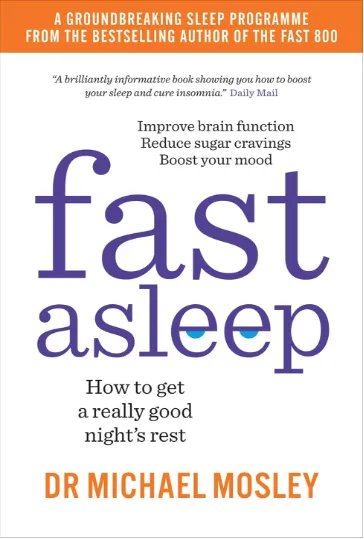
Fast Asleep: How to get a really good night's rest by Dr Michael Mosley
A good night's sleep is essential for a healthy brain and body. So why do so many of us struggle to sleep well? In Fast Asleep, Dr Michael Mosley explains what happens when we sleep, what triggers common sleep problems and why standard advice rarely works.
Prone to insomnia, he has taken part in numerous sleep experiments and tested every remedy going. The result is a radical, four-week programme, based on the latest science, designed to help you re-establish a healthy sleep pattern in record time.
With plenty of surprising recommendations - including tips for teenagers, people working night shifts and those prone to jet lag - plus recipes which will boost your deep sleep by improving your gut microbiome, Fast Asleep provides the tools you need to sleep better, reduce stress and feel happier.
We’re not just about overcoming obstacles, we’re about transforming lives.
Book Recommendation

Victoria Canham - Performance and People Strategic Partner
Victoria Canham is a senior Performance and People Strategic Partner, working with executive leaders and organisations when performance, culture, relationships and emotional pressure collide. She is an ICF-accredited Professional Coach and the founder of Victoria Canham Consultancy, a specialist practice focused on strengthening leadership capability, resilience, psychological safety and organisational performance in the real world, not just on paper.
With a background in behavioural insight, leadership psychology and large-scale change, Victoria supports senior leaders navigating strained relationships, brittle cultures, team fatigue and high-pressure decision-making. Her work helps leadership teams stabilise, communicate more effectively, rebuild trust and operate with greater clarity, humanity and authority.
She partners with CEOs, senior leaders and HR to address what is actually happening beneath performance headlines, guiding organisations through the conversations and capability shifts they cannot safely or effectively manage internally. The result is stronger leadership, healthier cultures, more resilient teams, and organisations better equipped to perform sustainably.
Follow us on social media


💸 Your people don’t leave for money. 💣 They leave for culture. 🔧 I fix that. 🏆 Retention & performance strategy that works.
Book a ☎️ | Fix the Leaks


© Copyright 2026 Victoria Canham Coaching | Website built by Me on FEA Create (aff.)
Performance Coaching Reading, London, Berkshire, Oxford | St George's Road, Reading, Berkshire, United Kingdom, RG30 2RL | +44 7377 527 529 | [email protected] Open Monday to Friday 9 am until 5 pm