
The Loneliness of Real Leadership
Victoria Canham • 18 March 2026 • 4 min read
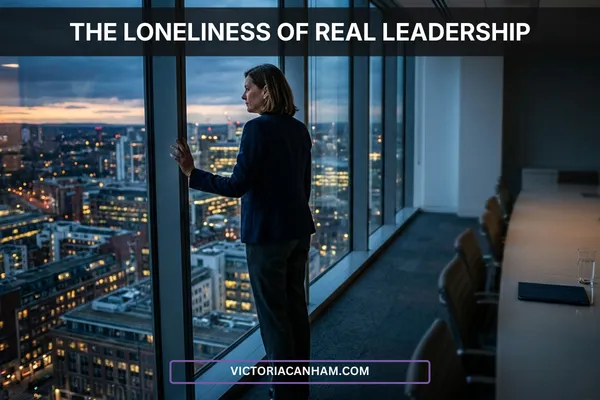
The higher you go, the fewer places there are to tell the truth.
There is a version of leadership that is easy to talk about, it is the one that appears in board packs and town halls. It is clear, composed, and measured, and it speaks to strategy, direction, and outcomes.
Then there is the version that leaders actually experience. It is less certain, likely more complex and definitely heavier than most people expect.
The nature of senior leadership means the leader’s circle has to narrow, because there are fewer environments in which they can think out loud without consequence, as well as fewer people they can speak with without managing how they are perceived. Of course, they also cannot be completely honest about what they are seeing and what they are unsure about in as many situations.
The Loss of Safe Conversation
Early in a career, leadership is more social. There are peers to test ideas with, colleagues to sense-check decisions, and space to admit uncertainty without it carrying wider meaning.
At the senior levels, that environment disappears and conversations are no longer neutral. Every word carries weight. A passing comment can shift how others interpret a leader’s confidence. A moment of hesitation can be read as doubt. A half-formed idea can travel further than intended.
Leaders learn this quickly.
So they become more precise, more considered, and more careful about what they say and where they say it. This is perceived as being more controlled, but to the leader, it can feel like restriction.
Pressure Does Not Arrive from One Direction
At the same time, the pressure does not come from just one place.
Boards and investors expect clarity and performance, employees expect direction and stability and peers expect consistency and sound judgement.
These expectations do not always align, and they rarely arrive at convenient moments.
Senior leaders are required to make decisions that will satisfy none of these groups completely, while maintaining confidence across all of them.
There is no version of the role where that becomes straightforward, but the leader will still learn to carry it.
Reputation Becomes Part of the Decision
What makes this harder is that decisions at this level are never purely operational.
They carry reputational risk and consequences.
A decision that lands poorly with the board can alter trust. A people issue handled badly can shift how leadership is perceived across the organisation. Moving too slowly can raise questions about capability. Moving too quickly can create resistance that is difficult to unwind.
Leaders are aware of all of this while they are making the call, so the thinking becomes more layered, more deliberate, more contained and certainly, more isolated.
Isolation is Often Self-Managed
Most senior leaders will not describe themselves as lonely; how could they? They are surrounded by people, they are in constant conversation and their diaries are full.
Yet, the isolation is the absence of a place where the full reality of the role can be spoken without being filtered, managed or critically judged.
Forcing leaders to adapt, hold more internally, resolve things themselves, relying on experience and instinct to carry them through decisions that feel heavier than they would like to admit.
That works, for a time, but the cost will start to show.
Decisions take longer than they should. Mental load increases. Relationships at the top of the organisation become more difficult to navigate because the important conversations are not fully being had.
Everything just becomes harder.
What Leaders Actually Need at this Level
The leaders who handle this well are not immune to the pressure; they have learnt to be more deliberate about how they deal with it.
They recognise that the role cannot be carried entirely on their own, no matter how experienced they are, so they create space.
Space to think clearly before the decision is made, to say what they are actually considering before it is refined into something presentable, to be challenged directly without the usual organisational dynamics shaping the conversation.
Sadly, that space is difficult to find in most organisations because internal relationships are already defined by hierarchy, history and consequence. Even well-intentioned conversations are influenced by those factors.
Which is why the most important leadership conversations are often the ones that do not happen at all.
What This Means in Practice
This is the work I am brought into.
Not to develop leaders in a generic sense, and not to run programmes that sit alongside the real work of the business. I work with leaders and leadership teams when the pressure is high and the usual conversations are no longer enough.
When relationships at the top are strained but still being managed, decisions are becoming harder to land and there is a growing sense that more is being held back than said.
Sometimes that work is with a CEO who needs a place to think clearly without consequence.
Sometimes it is with a leadership team that needs to address what has been left unresolved for too long.
In both cases, the role is the same.
To create a space where the truth can be spoken freely, and where the real work of leadership can actually happen.
A Reality Most Leaders Recognise
Leadership at this level becomes difficult in a very specific way.
You are the one who has to make the
call when there isn’t a clean answer. You know exactly who it will disappoint, and you still have to stand behind it.
You cannot share that fully with your team.
You cannot test it endlessly with your peers.
At some point, the decision sits with you.
That is where it starts to feel isolating, because you alone have to carry the consequences.
Strong leaders do not remove that pressure; they find a way to think clearly within it, which usually means having one place where they can speak plainly, before the decision is made, without managing how it lands. Just a space where they can be honest enough to decide properly.
♦️ Hi, I'm Victoria Canham. I work with senior leaders, executives, founders and organisations when performance, pressure and people dynamics reach a point where the usual tools stop working.
My work sits at the intersection of leadership psychology, organisational performance and culture reality. I help executive teams navigate strained relationships, cultural brittleness, emotional fatigue, and the quiet erosion of trust that most businesses prefer not to acknowledge.
This isn't "feel-good" leadership development. It is measured, commercially grounded support that builds capability, deepens emotional resilience, and helps leaders operate with greater clarity, strength and humanity.
♦️ How I support organisations and senior leaders:
Executive Advisory
I work alongside CEOs and senior leaders as a trusted, discreet thinking partner. We deal with the real conversations, the emotional load of leadership, decision-making under pressure, and the personal dynamics that affect performance and culture.
Leadership Facilitation & Development
I design high-level development that respects intelligence, emotional reality and commercial context. These programmes help leaders communicate better, hold difficult conversations safely, and lead in a way that is firm, clear and credible.
Culture, Performance & Retention Support
I help organisations stabilise culture and strengthen psychological safety in ways that shift behaviour and engagement — not just look impressive on a slide deck.
If your leadership team is under strain, if relationships feel tense, or if the culture is becoming brittle, it may be time for a different conversation.
Book a confidential call to talk openly, think clearly and work out what your organisation really needs. No theatrics. No fluffy platitudes. Just honest, expert partnership.
Follow me on LinkedIn for human, psychologically intelligent leadership that actually works in the real world.

Comment On This Article
Recommended Reading
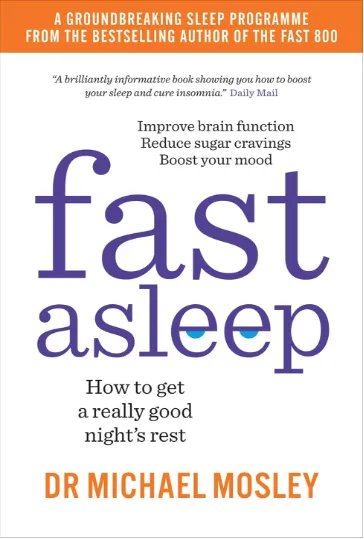
Fast Asleep: How to get a really good night's rest by Dr Michael Mosley
A good night's sleep is essential for a healthy brain and body. So why do so many of us struggle to sleep well? In Fast Asleep, Dr Michael Mosley explains what happens when we sleep, what triggers common sleep problems and why standard advice rarely works.
Prone to insomnia, he has taken part in numerous sleep experiments and tested every remedy going. The result is a radical, four-week programme, based on the latest science, designed to help you re-establish a healthy sleep pattern in record time.
With plenty of surprising recommendations - including tips for teenagers, people working night shifts and those prone to jet lag - plus recipes which will boost your deep sleep by improving your gut microbiome, Fast Asleep provides the tools you need to sleep better, reduce stress and feel happier.
We’re not just about overcoming obstacles, we’re about transforming lives.
Book Recommendation
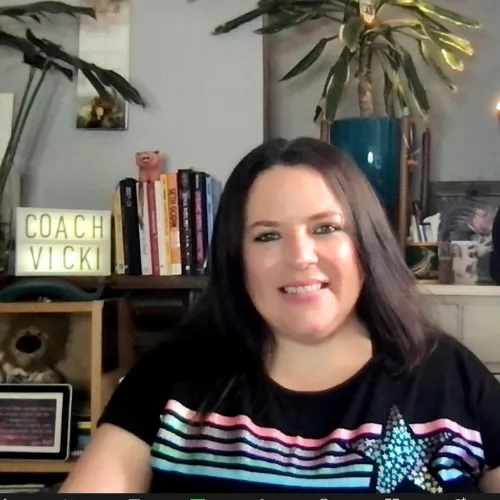
Victoria Canham - Performance and People Strategic Partner
Victoria Canham is a senior Performance and People Strategic Partner, working with executive leaders and organisations when performance, culture, relationships and emotional pressure collide. She is an ICF-accredited Professional Coach and the founder of Victoria Canham Consultancy, a specialist practice focused on strengthening leadership capability, resilience, psychological safety and organisational performance in the real world, not just on paper.
With a background in behavioural insight, leadership psychology and large-scale change, Victoria supports senior leaders navigating strained relationships, brittle cultures, team fatigue and high-pressure decision-making. Her work helps leadership teams stabilise, communicate more effectively, rebuild trust and operate with greater clarity, humanity and authority.
She partners with CEOs, senior leaders and HR to address what is actually happening beneath performance headlines, guiding organisations through the conversations and capability shifts they cannot safely or effectively manage internally. The result is stronger leadership, healthier cultures, more resilient teams, and organisations better equipped to perform sustainably.
Follow us on social media


💸 Your people don’t leave for money. 💣 They leave for culture. 🔧 I fix that. 🏆 Retention & performance strategy that works.
Book a ☎️ | Fix the Leaks


© Copyright 2026 Victoria Canham Coaching | Website built by Me on FEA Create (aff.)
Performance Coaching Reading, London, Berkshire, Oxford | St George's Road, Reading, Berkshire, United Kingdom, RG30 2RL | +44 7377 527 529 | [email protected] Open Monday to Friday 9 am until 5 pm