
The Perception Gap: Why Leaders Consistently Overestimate Trust, Safety, and Engagement
Victoria Canham • 2 December 2025 • 5 min read
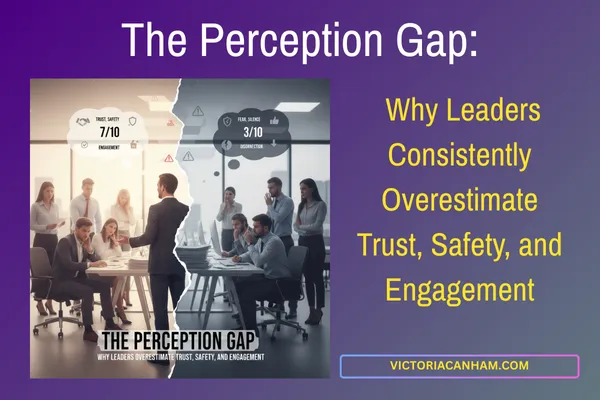
There's a pattern I see repeatedly when working with leaders on culture transformation.
I ask: "How would you rate psychological safety in your team?"
They answer: "Pretty good. Maybe 7 or 8 out of 10. We have open communication. People know they can come to me."
Then I speak with their teams.
The gap between what leaders believe and what teams experience is often staggering. Not by half a point. By 3, 4, sometimes 5 points on a 10-point scale.
This isn't because leaders are lying or delusional. It's a structural fault. There are systematic reasons why leaders consistently overestimate trust, safety, engagement, and communication quality in their organisations.
This perception gap is one of the most dangerous blind spots in leadership, because you can't fix what you don't see. And, if you believe everything is "pretty good," you won't look closely enough to spot what's actually happening.
Why the Gap Exists
1. You See a Curated Version of Reality
When you're in a position of power, people manage what you see.
Not maliciously, nor through elaborate deception, but simply through rational self-protection.
Your team knows you control:
✳️ Their compensation
✳️ Their career progression
✳️ Their work assignments
✳️ Their reputation within the organisation
So they show you a version of themselves and the situation that minimises risk.
What this looks like in practice:
In meetings with you present, people are more careful about what they say. Dissent gets softened. Concerns get hedged. Problems get minimised.
The honest conversations ("I can't believe we're doing this" and "this will never work") happen after you leave the room.
It's not that you're seeing dishonesty. It's more of a performance, one which is good enough that you can't always tell the difference.
2. Your Experience of Safety Is Different
As a leader, psychological safety feels different for you than it does for your team.
When you speak up, challenge an idea, or admit you don't know something, the stakes are lower. You have positional authority, so you're not worried about:
✳️ Looking incompetent in front of your boss
✳️ Being labelled "not a team player"
✳️ Getting passed over for promotion
✳️ Being first on the list when cuts happen
However, your team members are calculating all of these risks every time they consider speaking up.
The result:
What feels like a "pretty open" environment to you might feel considerably riskier to people with less power. Your 7 out of 10 might be their 4 out of 10, simply because your experience of risk is fundamentally different.
3. Negative Information Gets Filtered
Information flows up through layers of filtering. Each layer removes a bit more of the unfettered truth.
The pattern:
When a team member has a concern, they mention it to their immediate manager. The manager, wanting to appear competent and in control, softens the concern when reporting up. Their manager softens it further. By the time it reaches you, if it reaches you at all, it's been translated into something manageable.
You hear: "There are some minor concerns about the timeline, but the team is confident they can deliver."
What actually exists three layers down: "This timeline is impossible. We're going to fail, and everyone knows it, but no one wants to be the person who says it."
You're not receiving entirely dishonest information; rather, you're receiving information that's been filtered through multiple layers of risk management.
4. Confirmation Bias Amplifies the Gap
Once you believe your culture is "pretty good," you unconsciously look for evidence that confirms this belief and discount evidence that challenges it.
Someone speaks up in a meeting? "See, people feel comfortable sharing here."
Someone stays quiet? "They must not have anything to add."
Someone leaves? "They got a better offer; there's nothing we could have done. C'est la vie."
The same behaviours that would concern you if you believed there was a problem get explained away when you believe things are fine.
5. You Remember the Best Moments
Leaders often base their assessment on positive interactions they've had:
✳️ The time someone challenged your idea, and you handled it well
✳️ The productive one-on-one where someone was honest with you
✳️ The team member who thanked you for being approachable
These moments are real. But they may not be representative.
The question isn't: "Do some people sometimes feel safe with me?"
The question must be: "Do all people consistently feel safe with me?"
One person feeling comfortable enough to challenge you once doesn't mean everyone feels safe to do so regularly.
The Cost of the Perception Gap
When leaders overestimate trust, safety, and engagement, several things happen:
You Don't Investigate Further
If you believe things are "pretty good," you don't look closely. You don't ask probing questions, you don't observe carefully, and you don't seek disconfirming evidence.
The problems that exist stay hidden because you're not looking for them.
You Dismiss Warning Signs
When small signals appear, such as increased turnover, declining engagement scores, and hesitant questions, you explain them away rather than treating them as indicators of deeper issues.
"It's just a bad quarter."
"Industry-wide trend."
"A few people who weren't the right fit."
Meanwhile, the pattern continues.
You Make Decisions Based on Incomplete Information
If you don't know that people are hesitant to raise concerns, you make decisions without access to critical information. You move forward with initiatives that people know won't work. You miss risks that are obvious to those closer to the work.
Your decision-making quality suffers, not because you lack judgment, but because your information is incomplete.
You Lose Credibility
Perhaps most damaging: when there's a significant gap between your perception and your team's reality, they lose trust in your judgement.
If you consistently describe the culture as "open and collaborative" while they experience it as "careful and political," they conclude you either can't see reality or won't acknowledge it.
Either way, your credibility erodes.
How to Know If You Have a Perception Gap
Here are the warning signs:
1. Your assessment is consistently more positive than anonymous surveys or 360 feedback
If there's a pattern in which your view is 2+ points more optimistic than aggregated feedback, you have a perception gap.
2. People tell you things are fine, but behaviour suggests otherwise
✳️ Exit interviews are sanitised ("better opportunity"), but exit rates are climbing
✳️ People say they feel comfortable speaking up, but meetings are dominated by the same voices
✳️ Engagement scores are declining, but no one is telling you why
3. You're surprised by problems
When issues surface, they're often bigger than you expected or have been ongoing longer than you knew. This suggests information wasn't flowing to you effectively.
4. You can't remember the last time someone disagreed with you
If your team always seems aligned with your thinking, either you're brilliantly right about everything (unlikely), or people aren't comfortable challenging you (more likely).
5. Your team is more careful around you than around each other
If you notice meeting dynamics change when you join, or conversations pause when you approach, that's a signal.
6. People bring you solutions, not problems
If team members only come to you with fully-formed solutions rather than messy, half-baked problems they need help thinking through, they may not feel safe being uncertain around you.
The Cold Hard Truth
It's difficult to accept because you can't see your own blindspots. That's what makes them blindspots.
You can't simply "try harder to see" or "be more aware." The structural factors that create the perception gap, such as power dynamics, filtered information, and confirmation bias, operate whether you're conscious of them or not.
This is why external perspective matters and 360 feedback, culture assessments, and honest brokers who can tell you what they're really seeing are so valuable.
I'm not saying you're incompetent, quite the contrary, I am saying leaders create blind spots that are impossible to see from inside your own perspective.
What Comes Next
Recognising you might have a perception gap is the first step.
The next question is: What signals are you missing that are costing you talent and credibility?
In my next article, we'll explore the specific behavioural signals that reveal what's really happening in your team, and the patterns you can observe once you know what to look for.
Once you see the signals, you can start closing the gap between your perception and your team's reality, which is where real leadership begins - in the willingness to see what you've been missing.
ACT NOW: See Your Blindspots Before It's Too Late
The highest cost of the perception gap isn't bad engagement scores; it's losing your best people and eroding your credibility. You are ready to close this gap.
I work with leaders committed to seeing the real picture of their culture, performance, and employee journey. If you are ready to stop guessing and start leading with genuine, data-backed insight, let's secure your strategic advantage for 2026.
Book your confidential Strategy Call.
Don't wait to see the signals; start leading with clarity today.
This is Article 1 in "The Leadership Blindspot Series"
Coming next:
Article 2: The Signals You're Missing - What your team's behaviour is telling you
Article 3: Closing the Gap - How to rebuild credibility and see clearly
♦️ Hi. I'm Vicki, and I help businesses build high-performing, loyal teams by mastering the employee journey. I partner with leaders to drive tangible change, transforming company culture from a pretty promise on a slide deck into a daily reality. My approach goes beyond outdated HR strategies and gets to the heart of what truly motivates and retains your people.
Here's how I can support you:
Consulting & Coaching
I work directly with business leaders to diagnose and transform their employee experience, from culture to performance management. If you're ready to stop the cycle of burnout and build a team that thrives, not just survives, let's talk.
Click here to book a free 30-minute strategy call. No fluff, no sales pitches, just a direct conversation about your biggest challenges.
Talks & Keynotes
I deliver engaging keynotes that go beyond theory to provide actionable insights on leadership, culture, and performance. My talks are perfect for leadership teams and conferences looking to inspire real change.
Workshops & Training
My bespoke workshops and training sessions are designed to equip your leaders with the practical tools they need to build, manage, and retain exceptional teams. These are highly interactive sessions focused on creating measurable improvements in your business.
👉 Book a Clarity & Culture Call
Follow me on LinkedIn for more insights on building high-performing teams in 2025.


Comment On This Article
Recommended Reading
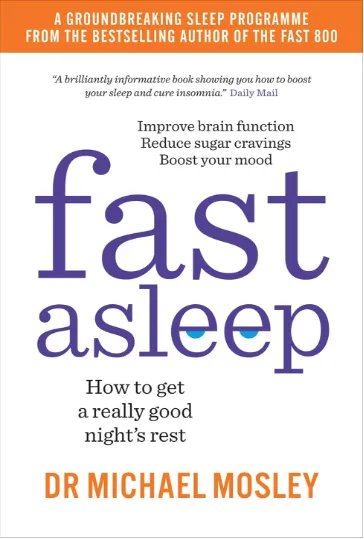
Fast Asleep: How to get a really good night's rest by Dr Michael Mosley
A good night's sleep is essential for a healthy brain and body. So why do so many of us struggle to sleep well? In Fast Asleep, Dr Michael Mosley explains what happens when we sleep, what triggers common sleep problems and why standard advice rarely works.
Prone to insomnia, he has taken part in numerous sleep experiments and tested every remedy going. The result is a radical, four-week programme, based on the latest science, designed to help you re-establish a healthy sleep pattern in record time.
With plenty of surprising recommendations - including tips for teenagers, people working night shifts and those prone to jet lag - plus recipes which will boost your deep sleep by improving your gut microbiome, Fast Asleep provides the tools you need to sleep better, reduce stress and feel happier.
We’re not just about overcoming obstacles, we’re about transforming lives.
Book Recommendation
Victoria Canham - Performance and People Strategic Partner
Victoria Canham is an ICF-accredited Certified Professional Coach and the founder of Victoria Canham Consultancy. We are a specialist performance consultancy partnering with senior leaders and HR teams to elevate culture, leadership, and employee experience. Rooted in behavioural insight and change expertise, we diagnose what's truly holding performance back, co-creating practical, strategic interventions that drive sustainable business results and build workplaces that work—for people and performance.
Follow us on social media


💸 Your people don’t leave for money. 💣 They leave for culture. 🔧 I fix that. 🏆 Retention & performance strategy that works.
Book a ☎️ | Fix the Leaks


© Copyright 2026 Victoria Canham Coaching | Website built by Me on FEA Create (aff.)
Performance Coaching Reading, London, Berkshire, Oxford | St George's Road, Reading, Berkshire, United Kingdom, RG30 2RL | +44 7377 527 529 | [email protected] Open Monday to Friday 9 am until 5 pm