Real Leadership Change Happens in Private; Not on Stage
Victoria Canham • 21 January 2026 • 6 min read
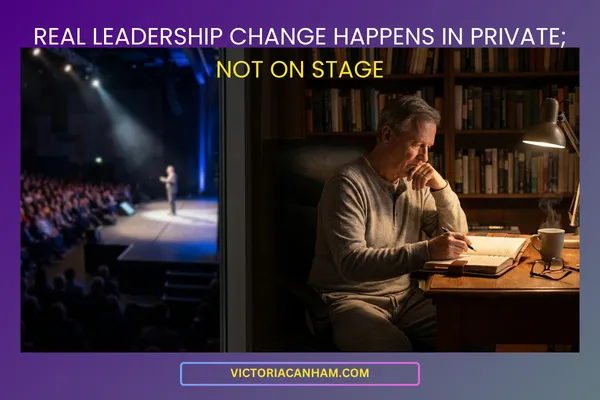
Leadership development has never been more visible.
There are programmes with glossy brochures, conferences with standing ovations, and leaders publicly committing to “new ways of leading” in carefully worded town halls and LinkedIn posts.
Most of it looks impressive, and it photographs well.
Very little of it changes how leaders actually behave when the pressure is on.
Organisations invest heavily in leadership capability and still find the same patterns repeating themselves: strained relationships, defensive decision-making, brittle cultures, exhausted executives and transformation efforts that stall in familiar ways.
At the most basic level, insight does not equal transformation, and performance on a stage does not translate into change in the boardroom.
Why Leadership Programmes Rarely Change Behaviour
Leadership programmes are not useless; in fact, they are excellent at producing awareness. They expose people to new ideas. They create space for reflection. They build networks. They signal that an organisation cares about development.
However, exposure to an idea is not the same as integration of that idea. Integration does not happen in a room full of peers. Programmes rarely change how a leader responds under threat, handles conflict, tolerates uncertainty or relates to power.
Here is what typically happens: a leader attends a programme. They encounter a concept that resonates. They nod. They take notes. They commit to applying it. They return to their role with a genuine intention to lead differently.
Then pressure hits.
A crisis emerges.
A conflict escalates.
A decision needs to be made.
In that moment, under that pressure, the leader does not reach for the new concept. They reach for the pattern that
has kept them safe for twenty years, because knowing something intellectually and being able to embody it under pressure are entirely different things.
When the pressure returns, the organisation pays the price for the operating patterns the senior leaders revert to.
Leadership change is not about learning new terminology and frameworks. It is about altering how you relate to yourself, power, conflict, uncertainty, and responsibility. No matter how much we wish it would, that work simply does not happen in a workshop. It happens in the repetitive, private, often uncomfortable work of examining your own patterns and choosing differently, again and again, until the new response becomes as instinctive as the old one.
Why Real Change Is So Rare
Senior leaders struggle because success builds habits, habits become identity, and identity becomes difficult to question.
Many of the behaviours that once made a leader effective eventually become the very behaviours that limit them.
Control once created safety.
Decisiveness once created credibility.
Emotional distance once created authority.
Over time, those same strategies narrow thinking, strain relationships, and erode trust.
This is where most leadership development fails.
It teaches leaders what to do differently, without supporting them to become someone different internally.
Real leadership change is not primarily behavioural. It is relational. It changes how you relate to yourself, power, conflict, uncertainty and responsibility.
The Role of Emotional Capacity
A leader can know exactly what they should do in a moment of conflict and still avoid the conversation because they do not have the emotional range to hold the discomfort. They can understand the value of vulnerability and still display certainty because they have never built the capacity to tolerate uncertainty. They can believe in distributed leadership and still centralise control because letting go feels like losing grip on their own worth.
Emotional capacity is the ability to stay present with discomfort, ambiguity, and uncertainty without defaulting to control, withdrawal, or performance. It is the ability to tolerate conflict without needing to resolve it immediately. It is the ability to hold others' emotions without absorbing them or shutting them down. It is the ability to lead from a grounded place rather than a defensive one.
Building that capacity is not something you can do in a two-day workshop. It requires repetition, reflection, and relational support. It requires someone who can name the pattern you are avoiding, hold you accountable to the change you said you wanted, and create enough safety for you to practice a different way of being.
The leaders who create the healthiest cultures and the strongest performance are not the most charismatic or the most technically gifted; they are the most emotionally mature.
Emotional capacity determines:
• how much uncertainty a leader can tolerate without becoming controlling
• how much challenge they can receive without becoming defensive
• how much responsibility they can carry without becoming brittle
• how safe others feel speaking honestly in their presence
When emotional capacity is limited, leadership becomes tense and brittle. Authority becomes tense. Performance becomes expensive.
When emotional capacity expands, leadership changes quietly but profoundly. Decision-making stabilises. Relationships soften. Culture becomes safer without anyone having to announce it.
This is why insight alone is insufficient.
Without emotional re-patterning, leaders may understand what needs to change and yet remain unable to change it.
Why Private Work Changes More Than Public Programmes
Group programmes operate on the assumption that leadership development can be standardised. The thinking is that if you put ten senior leaders in a room and give them the same content, they will all grow in roughly the same way.
However, leadership is not standardised, because people are not standardised. Every leader carries different patterns, different wounds, different compensations, and different strengths that have hardened into limitations. The work of changing those patterns is deeply individual.
This is why 1:1 executive work has a durability that group programmes do not.
In private, a leader can name what they are actually struggling with, without having to sanitise it to make it digestible to peers, team members or even more senior leaders. The fear that if they stop controlling everything, it will all fall apart. The shame of not knowing the answer. The exhaustion of carrying everyone else's anxiety. The unspoken terror that if they lead differently, they will be seen as weak. The fear that their reputation is at risk if they remove the armour.
In private, there is no performance and no need to appear composed, insightful, or further along than you are. Just the truth of what is actually happening, and the space to work with it without judgment.
In that space, real change becomes possible. The work is not about learning a framework. It is about examining the operating system you are running, understanding where it came from, recognising what it is costing you, and building the capacity to run a different one.
The Behind-The-Scenes Work That Changes Results
The leaders who evolve most successfully rarely talk about it publicly.
There are no announcements, no visible breakthroughs and probably no applause.
There is simply a gradual shift.
A leader who listens differently.
Who pauses before reacting.
Who holds conflict without escalating it.
Who makes decisions with clarity rather than urgency.
Who creates psychological safety without ever using the phrase.
Over time, the organisation feels it.
Meetings become cleaner.
Relationships become less brittle.
Culture becomes more honest.
Performance becomes sustainable.
This is not development people applaud.
It is development that changes results.
This Is the Work I Do
I work with senior leaders privately, discreetly and seriously, supporting the internal shifts that no programme can manufacture and no keynote can deliver.
This is not motivational coaching.
It is not performance theatre.
It is identity-level leadership evolution.
The work people never see, and the work that changes everything.
If you are leading meaningful change in 2026 and recognise that the real shift may need to begin with you, I would welcome a conversation.
Not about frameworks.
About who you are under pressure, how you lead when it is difficult, and who you are becoming.
What This Work Actually Looks Like
The leaders I work with do not come to me because they need a new strategy. They come because they have hit a ceiling, and they know the ceiling is them.
They are exceptional at what they do and have delivered results for years. They are respected, relied upon, and often over-relied upon. And they are exhausted. Not because they are working too hard, though they are, but because the version of leadership they are performing is no longer sustainable.
They need space to stop performing. To admit what is not working. To examine the patterns they have been running without judgment. To grieve the version of themselves they have to let go of. To build the emotional capacity to lead in a way that does not deplete them.
This work does not happen in a boardroom. It does not happen in front of their team. It happens in private sessions where we look at what is actually driving their behaviour, where it came from, and what it would take to choose differently.
We do not talk about it publicly. We do not announce it. Because the work is not for external validation. It is for internal transformation.
And when it works, the results are unmistakable. Not because the leader suddenly has all the answers, but because they have changed how they hold themselves in relation to not having them. Not because they have become a different person, but because they have become more of who they actually are, rather than who they had to be to survive.
The Invitation
If you are reading this and recognising that the version of leadership you are performing is no longer sustainable, you are not failing. You are ready for something different.
This is the work I do with leaders. The work people rarely applaud, and the work that changes results.
If you want a strategic thinking partner for that work, I would welcome a conversation. Click here.
I don't help leaders cope with their jobs. I help them become the leaders their future requires.
♦️ Hi, I’m Vicki. I work with senior leaders and organisations when performance, pressure and people dynamics reach a point where the usual tools no longer work.
My work sits at the intersection of leadership psychology, organisational performance and culture reality. I help executive teams navigate strained relationships, cultural brittleness, emotional fatigue, and the quiet erosion of trust and performance that most businesses prefer not to acknowledge.
This isn’t “feel-good” leadership development. It is measured, commercially grounded support that builds capability, deepens emotional resilience, strengthens psychological safety and helps leaders operate with greater clarity, strength and humanity.
♦️ How I support organisations and senior leaders:
Executive Advisory
I work alongside CEOs and senior leaders as a trusted, discreet thinking partner. Together we deal with the real conversations, the emotional load of leadership, decision-making under pressure, and the personal and relational dynamics that affect performance and culture.
Leadership Facilitation & Development
I design and deliver high-level leadership development that respects intelligence, emotional reality and commercial context. These programmes help leaders communicate better, hold difficult conversations safely, build trust, and lead in a way that is firm, clear, compassionate and credible.
Culture, Performance & Retention Support
I help organisations stabilise culture, strengthen psychological safety and improve employee experience in a way that actually shifts behaviour, engagement and performance rather than simply looking impressive on a slide deck.
If your leadership team is under emotional strain, if relationships feel tense, or if the culture is becoming brittle, it may be time for a different kind of conversation.
You can book a confidential Clarity & Culture Call to talk openly, think clearly and work out what your organisation really needs. No theatrics. No fluffy platitudes. Just honest, expert partnership.
Follow me on LinkedIn if you’re interested in human, psychologically intelligent leadership, performance, resilience and culture that actually works in the real world.


Comment On This Article
Recommended Reading
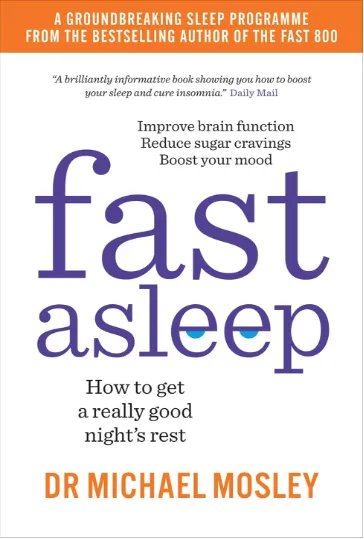
Fast Asleep: How to get a really good night's rest by Dr Michael Mosley
A good night's sleep is essential for a healthy brain and body. So why do so many of us struggle to sleep well? In Fast Asleep, Dr Michael Mosley explains what happens when we sleep, what triggers common sleep problems and why standard advice rarely works.
Prone to insomnia, he has taken part in numerous sleep experiments and tested every remedy going. The result is a radical, four-week programme, based on the latest science, designed to help you re-establish a healthy sleep pattern in record time.
With plenty of surprising recommendations - including tips for teenagers, people working night shifts and those prone to jet lag - plus recipes which will boost your deep sleep by improving your gut microbiome, Fast Asleep provides the tools you need to sleep better, reduce stress and feel happier.
We’re not just about overcoming obstacles, we’re about transforming lives.
Book Recommendation
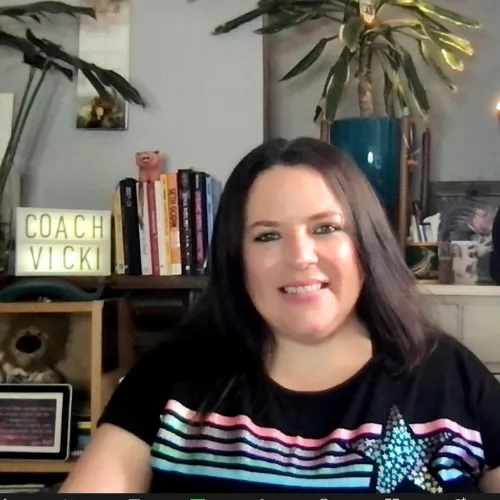
Victoria Canham - Performance and People Strategic Partner
Victoria Canham is a senior Performance and People Strategic Partner, working with executive leaders and organisations when performance, culture, relationships and emotional pressure collide. She is an ICF-accredited Professional Coach and the founder of Victoria Canham Consultancy, a specialist practice focused on strengthening leadership capability, resilience, psychological safety and organisational performance in the real world, not just on paper.
With a background in behavioural insight, leadership psychology and large-scale change, Victoria supports senior leaders navigating strained relationships, brittle cultures, team fatigue and high-pressure decision-making. Her work helps leadership teams stabilise, communicate more effectively, rebuild trust and operate with greater clarity, humanity and authority.
She partners with CEOs, senior leaders and HR to address what is actually happening beneath performance headlines, guiding organisations through the conversations and capability shifts they cannot safely or effectively manage internally. The result is stronger leadership, healthier cultures, more resilient teams, and organisations better equipped to perform sustainably.
Follow us on social media


💸 Your people don’t leave for money. 💣 They leave for culture. 🔧 I fix that. 🏆 Retention & performance strategy that works.
Book a ☎️ | Fix the Leaks


© Copyright 2026 Victoria Canham Coaching | Website built by Me on FEA Create (aff.)
Performance Coaching Reading, London, Berkshire, Oxford | St George's Road, Reading, Berkshire, United Kingdom, RG30 2RL | +44 7377 527 529 | [email protected] Open Monday to Friday 9 am until 5 pm