
Taking Responsibility In a Culture You Didn’t Create
Victoria Canham •8 April 2026 • 4 min read
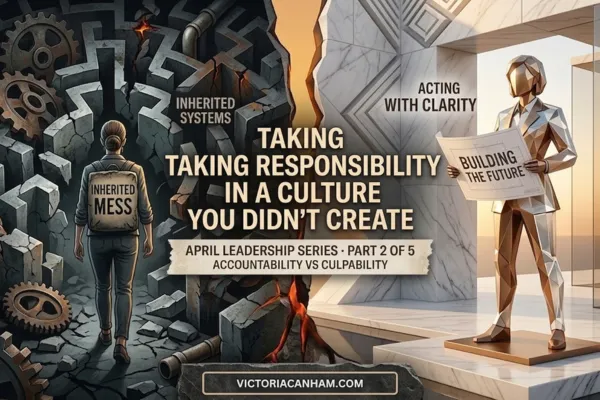
You didn’t build this. You didn’t design these systems or install these behaviours. And none of that changes what you’re responsible for now.
There is a particular kind of leadership situation that none of us enjoy and that’s the one where you inherit the mess.
You step into a business, a division, a leadership team and what you find is not what was described. The culture is fractured, and the behaviours that drove the fracture are embedded within it. The people who modelled those behaviours are either still in the room or gone but not forgotten; their influence remains present in everything from how decisions get made to what people are allowed to talk about.
You didn’t create any of it, yet you are still responsible for what happens next.
The adaptation that outlasted the crisis
Under sustained pressure, leaders adapt and become faster, harder, more decisive. They stop tolerating ambiguity because ambiguity costs time they don't have. They stop consulting because consultation slows things down. They stop showing uncertainty because uncertainty spreads.
In a crisis, they're often exactly right.
The problem is that the crisis ends, but the adaptation doesn't. The leader who stopped asking questions because there was no time is now the leader who doesn't ask questions. The leader who centralised decisions because the stakes were too high is now the leader who can't let go. The leader who buried doubt because it was contagious is now the leader no one can have a real conversation with.
Most of them know this, but just haven't looked it directly in the eye and admitted it.
The temptation to wait it out
Most leaders in this position make a sensible-sounding calculation: move carefully, build trust, understand the landscape before acting. Don’t come in swinging. Don’t make enemies before you’ve made allies.
Sometimes that is the right approach, but that’s not always being cautious; it’s pure avoidance dressed in the language of strategy. The leader who is still ‘listening and learning’ at month six, or who has identified the problem but is waiting for the right moment to act, or the one who knows exactly what needs to change and has decided that the political cost is too high right now.
And so, the moment never arrives, the cost never drops. In the meantime, every week you operate in a culture without addressing the problems is another week where you’ve endorsed it.
The distinction that changes everything
There is a difference between accountability and culpability that is often conflated in this situation, and that conflation is what keeps them stuck.
Culpability is about cause. You are culpable for what you created, what you sanctioned, and what you failed to stop when it was your responsibility to stop it. The leader before you carries culpability for the culture they built. The systems they rewarded. The behaviours they tolerated or modelled.
Accountability is about what happens next. You are accountable for the organisation from the moment you take responsibility for it, regardless of what you found when you arrived. You don’t get to exempt yourself from outcomes because you didn’t cause the inputs.
This distinction is where authority comes from.
The leader who says ‘this isn’t my fault’ is correct, but it doesn’t matter. The leader who says ‘this is my responsibility’, even when they didn’t cause it, is the one people will actually follow into the change that needs to happen.
Where your responsibility starts and stops
This is the question leaders in inherited dysfunction ask most often, and there is no easy answer with clear boundaries.
You are not responsible for fixing everything simultaneously. You are not responsible for outcomes that were in motion before you arrived and that no reasonable intervention could have changed. You are not responsible for the choices other leaders made before you had authority.
You are responsible for what you see and do not address because the relationship is too important, or the timing isn’t right, or you’re not sure how the board will react. You are responsible for the systems you inherit and continue operating without question because changing them would be slow and difficult and you have other priorities.
The distinction is not in what you caused, but what you chose to see and what you chose to do with what you saw.
Acting without full control
The constraint here is real, and it doesn’t go away: you must act without full control, and then live with the ambiguity of not knowing whether you acted correctly.
Every choice has a political cost. Call out the behaviour, risk the relationship; challenge the legacy system, risk the people who built their identity around it; move too fast, you’re reckless; move too slowly, you’re complicit. There is no path through inherited dysfunction that doesn’t require spending political capital you may not have earned yet.
What experienced leaders know, and many take too long to accept, is that waiting for control before acting is unrealistic. You will not get full control. The ambiguity will not be resolved before you need to move. The question is whether you act with clarity about what you’re doing and why.
That clarity is knowing what you’re accountable for, understanding the difference between cause and responsibility, calling out what you see even when it’s politically expensive and knowing that none of this is a guarantee of the right outcome.
It is, however, the only basis on which real change inside a broken culture ever starts.
This is Part 2 of a five-part April series on leadership, constraint, and consequence. Next: The Conversation You Keep Avoiding.
♦️ Hi, I'm Victoria Canham. I work with senior leaders, executives, founders and organisations when performance, pressure and people dynamics reach a point where the usual tools stop working.
My work sits at the intersection of leadership psychology, organisational performance and culture reality. I help executive teams navigate strained relationships, cultural brittleness, emotional fatigue, and the quiet erosion of trust that most businesses prefer not to acknowledge.
This isn't "feel-good" leadership development. It is measured, commercially grounded support that builds capability, deepens emotional resilience, and helps leaders operate with greater clarity, strength and humanity.
♦️ How I support organisations and senior leaders:
Executive Advisory
I work alongside CEOs and senior leaders as a trusted, discreet thinking partner. We deal with the real conversations, the emotional load of leadership, decision-making under pressure, and the personal dynamics that affect performance and culture.
Leadership Facilitation & Development
I design high-level development that respects intelligence, emotional reality and commercial context. These programmes help leaders communicate better, hold difficult conversations safely, and lead in a way that is firm, clear and credible.
Culture, Performance & Retention Support
I help organisations stabilise culture and strengthen psychological safety in ways that shift behaviour and engagement — not just look impressive on a slide deck.
If your leadership team is under strain, if relationships feel tense, or if the culture is becoming brittle, it may be time for a different conversation.
Book a confidential call to talk openly, think clearly and work out what your organisation really needs. No theatrics. No fluffy platitudes. Just honest, expert partnership.
Follow me on LinkedIn for human, psychologically intelligent leadership that actually works in the real world.

Comment On This Article
Recommended Reading
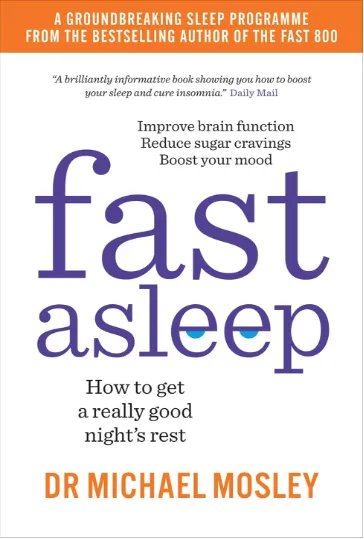
Fast Asleep: How to get a really good night's rest by Dr Michael Mosley
A good night's sleep is essential for a healthy brain and body. So why do so many of us struggle to sleep well? In Fast Asleep, Dr Michael Mosley explains what happens when we sleep, what triggers common sleep problems and why standard advice rarely works.
Prone to insomnia, he has taken part in numerous sleep experiments and tested every remedy going. The result is a radical, four-week programme, based on the latest science, designed to help you re-establish a healthy sleep pattern in record time.
With plenty of surprising recommendations - including tips for teenagers, people working night shifts and those prone to jet lag - plus recipes which will boost your deep sleep by improving your gut microbiome, Fast Asleep provides the tools you need to sleep better, reduce stress and feel happier.
We’re not just about overcoming obstacles, we’re about transforming lives.
Book Recommendation
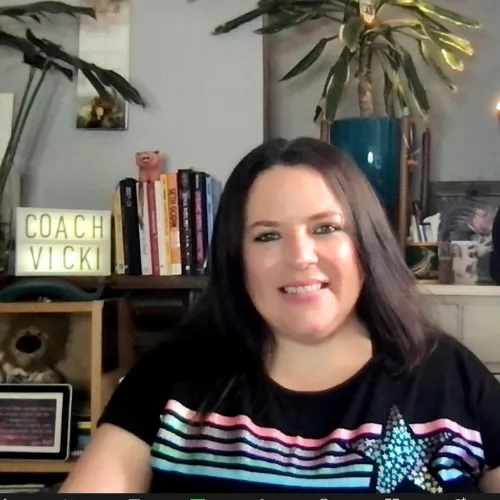
Victoria Canham - Performance and People Strategic Consultant
Victoria Canham works with executive leaders and organisations when performance, culture and emotional pressure collide.
She is a Change Leader with over 25 years of experience, an ICF-accredited Professional Coach and founder of Victoria Canham Consultancy. Her practice focuses on strengthening leadership capability and organisational performance in the real world, not just on paper.
With twenty-five years in talent development, behavioural insight and large-scale change, she supports senior leaders navigating strained relationships, brittle cultures and high-pressure decision-making. Her work helps leadership teams stabilise, rebuild trust and operate with greater clarity and authority.
She is brought in when organisations cannot safely hold difficult conversations internally—when executive teams have stopped saying what needs saying, when founders need to step back, when high-performing individuals are costing more than they deliver. She creates the conditions where those conversations can actually happen, and where organisations can move forward from them.
The result is leadership that functions under pressure, cultures that hold up in practice, and teams equipped to perform sustainably.
Follow us on social media


💸 Your people don’t leave for money. 💣 They leave for culture. 🔧 I fix that. 🏆 Retention & performance strategy that works.
Book a ☎️ | Fix the Leaks


© Copyright 2026 Victoria Canham Coaching | Website built by Me on FEA Create (aff.)
Performance Coaching Reading, London, Berkshire, Oxford | St George's Road, Reading, Berkshire, United Kingdom, RG30 2RL | +44 7377 527 529 | [email protected] Open Monday to Friday 9 am until 5 pm