Stop Asking for Permission to Lead
Victoria Canham • 11 March 2026 • 4 min read
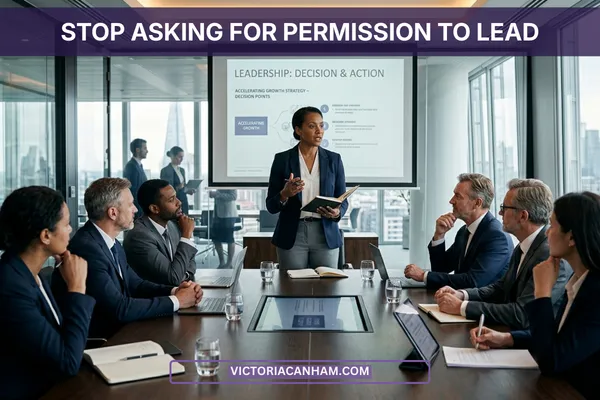
There is a pattern I see in many senior leadership teams; on paper, these are the people running the organisation. They hold the titles, the authority and the salaries that signal seniority. They have years of experience and strong track records.
Yet in the room together, they often behave like middle managers.
Decisions are softened before they are spoken, opinions are carefully tested before anyone commits to them, and difficult calls are delayed while another round of “alignment” takes place.
Everyone is waiting to see where the safe ground is.
The problem is that senior leadership does not and cannot work like that. At some point, someone has to lead.
The Habit of Asking for Permission
Many executives have spent years inside organisations where success depended on reading the room well.
They learned how to build consensus, how to navigate hierarchy and how to avoid stepping too far ahead of the group. These skills help people rise through organisations. They are useful and often necessary, but the job changes at the top.
Once someone sits on the executive team, the organisation is no longer asking them to interpret leadership. It is asking them to provide the leadership.
That shift sounds obvious, yet in practice it is surprisingly difficult.
You see it when leaders phrase decisions as suggestions. You see it when they wait to see whether the CEO reacts positively before committing to a view. You see it when an executive team spends two hours discussing something that everyone in the room already knows the answer to.
It is not a capability issue.
It is a habit of seeking permission that was never fully unlearned.
Endless Alignment is NOT Leadership
Alignment matters in organisations. No serious leader would argue otherwise, but alignment can also become a convenient delay mechanism.
Another meeting. Another round of feedback. Another attempt to make the decision feel comfortable for everyone involved.
What is presented as collaboration is often hesitation.
The organisation feels it because teams begin to notice that decisions take far longer than they should, strategy moves slowly because every step must pass through several layers of reassurance before anyone commits to it (think 6-stage interviews).
Eventually, people stop expecting clarity from the top. They work around it instead.
When Leaders Soften the Decision They Already Know is Right
One of the most common moments I see with senior leaders happens just before a difficult decision.
The facts are clear, the implications are understood, most people in the room privately know what needs to happen; yet the person responsible hesitates.
They soften the message, open the floor again, and ask for one more view in case someone disagrees strongly enough to change the direction.
Sometimes this comes from good intentions. Leaders do not want to bulldoze others or ignore legitimate concerns.
The result is usually the same.
A decision that should have taken ten minutes stretches into weeks.
And when the call is finally made, it is often the same one that could have been taken at the start.
Boards Notice Sooner than Leadership Teams Think
When executive teams struggle to hold authority in this way, boards tend to notice, maybe not immediately, because they are careful about drawing conclusions too quickly, but patterns become visible over time.
Strategy shifts repeatedly without clear explanations, execution slows and issues return to the board agenda several times without resolution.
Directors begin to wonder whether the leadership team is fully confident in its own judgement, confidence erodes steadily, and by the time the concern is voiced directly, the organisation has usually been feeling the effects for some time.
Leadership Requires a Degree of Discomfort
Many senior leaders are thoughtful, intelligent people who care about the impact of their decisions.
That is a strength.
It can also make leadership harder.
When you understand the consequences of your choices, the temptation is to keep refining the decision until the risk feels manageable. Unfortunately, leadership rarely offers that level of certainty.
There are moments when the role requires you to make the call anyway, without waiting for the room to make the decision safe.
Leadership often means disappointing someone in the process.
The longer leaders try to avoid that reality, the harder the role becomes.
The Shift that Changes Everything
The strongest senior leaders eventually make a shift in how they think about their role. That is, they stop trying to manage the reactions in the room.
Instead, they focus on the quality of their judgement and the clarity with which they communicate it.
They listen carefully to challenge, adjust if someone presents better information, but they do not retreat from the responsibility of deciding.
That steadiness changes the dynamic of the entire leadership team.
Communication becomes more succinct, more direct - shorter meetings, concise conversations and a collective knowledge that decisions will actually move forward.
The organisation begins to feel led again.
The Responsibility of Senior Leadership
By the time someone reaches an executive role, they have already proven their capability many times over.
The question that remains is different.
Are they prepared to hold the authority that comes with the role?
That means making calls when the answer will not please everyone. It means addressing behaviour that others might prefer to ignore. It means providing direction when the organisation would happily spend another month discussing options.
This is the responsibility of senior leadership.
Leaders don't need to dominate every conversation, but the organisation needs clarity somewhere.
When leadership teams stop asking for permission to lead, the effect is immediate.
Decisions accelerate. Politics loses some of its power. People regain confidence that the organisation knows where it is going.
Nothing dramatic has changed on the surface. The leaders have simply stepped fully into the role they already hold.
♦️ Hi, I'm Victoria Canham. I work with senior leaders, executives, founders and organisations when performance, pressure and people dynamics reach a point where the usual tools stop working.
My work sits at the intersection of leadership psychology, organisational performance and culture reality. I help executive teams navigate strained relationships, cultural brittleness, emotional fatigue, and the quiet erosion of trust that most businesses prefer not to acknowledge.
This isn't "feel-good" leadership development. It is measured, commercially grounded support that builds capability, deepens emotional resilience, and helps leaders operate with greater clarity, strength and humanity.
♦️ How I support organisations and senior leaders:
Executive Advisory
I work alongside CEOs and senior leaders as a trusted, discreet thinking partner. We deal with the real conversations, the emotional load of leadership, decision-making under pressure, and the personal dynamics that affect performance and culture.
Leadership Facilitation & Development
I design high-level development that respects intelligence, emotional reality and commercial context. These programmes help leaders communicate better, hold difficult conversations safely, and lead in a way that is firm, clear and credible.
Culture, Performance & Retention Support
I help organisations stabilise culture and strengthen psychological safety in ways that shift behaviour and engagement — not just look impressive on a slide deck.
If your leadership team is under strain, if relationships feel tense, or if the culture is becoming brittle, it may be time for a different conversation.
Book a confidential call to talk openly, think clearly and work out what your organisation really needs. No theatrics. No fluffy platitudes. Just honest, expert partnership.
Follow me on LinkedIn for human, psychologically intelligent leadership that actually works in the real world.

Comment On This Article
Recommended Reading
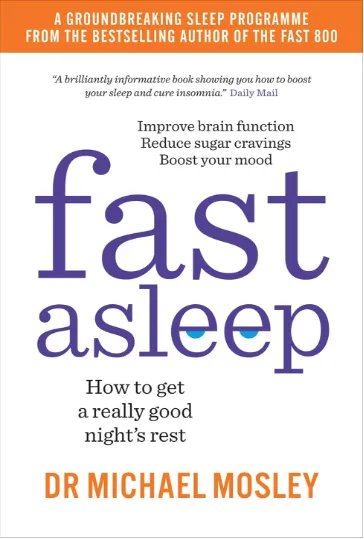
Fast Asleep: How to get a really good night's rest by Dr Michael Mosley
A good night's sleep is essential for a healthy brain and body. So why do so many of us struggle to sleep well? In Fast Asleep, Dr Michael Mosley explains what happens when we sleep, what triggers common sleep problems and why standard advice rarely works.
Prone to insomnia, he has taken part in numerous sleep experiments and tested every remedy going. The result is a radical, four-week programme, based on the latest science, designed to help you re-establish a healthy sleep pattern in record time.
With plenty of surprising recommendations - including tips for teenagers, people working night shifts and those prone to jet lag - plus recipes which will boost your deep sleep by improving your gut microbiome, Fast Asleep provides the tools you need to sleep better, reduce stress and feel happier.
We’re not just about overcoming obstacles, we’re about transforming lives.
Book Recommendation
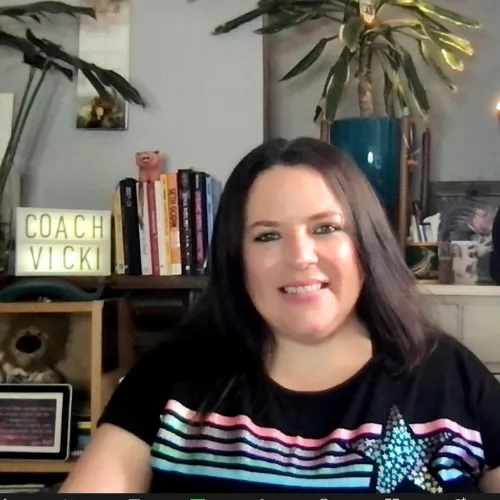
Victoria Canham - Performance and People Strategic Partner
Victoria Canham is a senior Performance and People Strategic Partner, working with executive leaders and organisations when performance, culture, relationships and emotional pressure collide. She is an ICF-accredited Professional Coach and the founder of Victoria Canham Consultancy, a specialist practice focused on strengthening leadership capability, resilience, psychological safety and organisational performance in the real world, not just on paper.
With a background in behavioural insight, leadership psychology and large-scale change, Victoria supports senior leaders navigating strained relationships, brittle cultures, team fatigue and high-pressure decision-making. Her work helps leadership teams stabilise, communicate more effectively, rebuild trust and operate with greater clarity, humanity and authority.
She partners with CEOs, senior leaders and HR to address what is actually happening beneath performance headlines, guiding organisations through the conversations and capability shifts they cannot safely or effectively manage internally. The result is stronger leadership, healthier cultures, more resilient teams, and organisations better equipped to perform sustainably.
Follow us on social media


💸 Your people don’t leave for money. 💣 They leave for culture. 🔧 I fix that. 🏆 Retention & performance strategy that works.
Book a ☎️ | Fix the Leaks


© Copyright 2026 Victoria Canham Coaching | Website built by Me on FEA Create (aff.)
Performance Coaching Reading, London, Berkshire, Oxford | St George's Road, Reading, Berkshire, United Kingdom, RG30 2RL | +44 7377 527 529 | [email protected] Open Monday to Friday 9 am until 5 pm