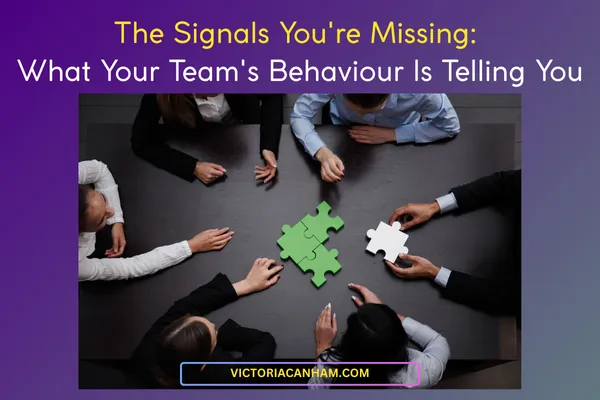
The Signals You're Missing: What Your Team's Behaviour Is Telling You
Victoria Canham • 9 December 2025 • 7 min read
In my last article, we explored the perception gap: why leaders consistently overestimate trust, safety, and engagement in their teams. We examined the structural reasons this gap exists and why you can't simply "try harder" to see it.
Now comes the practical question: If people aren't telling you what's really happening, how do you know?
The answer: You watch what they do, not what they say.
Words can be managed, but behaviour is much harder to hide.
Over years of culture transformation work, I've learned to read the signals that reveal what's really happening in an organisation. These aren't subtle tea-leaf readings that require expert interpretation. Once you know what to look for, they become glaringly obvious.
This article is your field guide to the behavioural signals that reveal truth when words won't.
Why Behaviour Reveals More Than Words
When there's a power dynamic, people manage their words carefully. They've learned what's safe to say and what isn't. They know how to frame concerns diplomatically, how to soften bad news, how to phrase disagreement as "just a thought."
But behaviour is harder to control consistently.
The hesitation before someone speaks. The energy in a room when you enter versus when you leave. Who talks and who doesn't. What gets discussed in meetings versus what gets discussed after them.
These patterns reveal the truth that words are too risky to say out loud.
Signal 1: The Quality of Silence
Not all silence is the same. There's comfortable silence (people thinking, processing, reflecting) and there's tense silence (people calculating risk)..
Comfortable silence feels:
✳️ Natural, not forced
✳️ Like space for thinking
✳️ Distributed (everyone seems equally comfortable with it)
✳️ Temporary (someone speaks without visible effort)
Tense silence feels:
✳️ Heavy, loaded
✳️ Like everyone's waiting for someone else to go first
✳️ Concentrated (some people are comfortable, others visibly aren't)
✳️ Extended (it takes visible courage for someone to break it)
What to observe:
✳️ After you ask a question in a meeting, notice:
✳️ How long the pause lasts
✳️ People's body language during the pause (looking down, fidgeting, glancing at each other)
✳️ Whether the same person always breaks the silence
✳️ The energy of the first response (confident or hedged)
What it means:
If silence after your questions consistently feels tense, people are calculating whether it's safe to respond honestly. They're not thinking about the answer—they're thinking about the risk of answering.
Signal 2: The Language of Self-Protection
People who feel unsafe develop a linguistic pattern designed to protect them from judgment.
Listen for:
Excessive hedging:
✳️ "I might be wrong, but..."
✳️ "This is probably just me, but..."
✳️ "I don't want to be negative, but..."
✳️ "I'm sure there's a good reason, but..."
Pre-emptive apologies:
✳️ "Sorry, this might be a stupid question..."
✳️ "Sorry to bring this up again..."
✳️ "Sorry if I'm missing something obvious..."
Responsibility diffusion:
✳️ "Some people are saying..." (rather than "I think")
✳️ "There's been some concern..." (rather than "I'm concerned")
✳️ "It's been mentioned..." (passive voice, no owner)
Permission-seeking:
✳️ "Would it be okay if I asked..."
✳️ "Do you mind if I bring up..."
✳️ "Is this a good time to mention..."
What it means:
This language is armour. People are protecting themselves from the judgment, dismissal, or negative consequences they've learned to expect when they speak up.
The more hedging and apologising you hear, the less safe people feel being direct with you.
Signal 3: Who Speaks and Who Doesn't
Voice distribution in meetings reveals power dynamics and safety with remarkable accuracy.
What to observe:
Track across multiple meetings:
✳️ Who speaks first, most often, and longest
✳️ Who only speaks when directly asked
✳️ Who gets interrupted and who doesn't
✳️ Whose ideas get built upon versus dismissed
✳️ Whether voice correlates with seniority, function, or identity
Patterns that signal low safety:
✳️ The same 2-3 people dominate every discussion
✳️ Junior people are silent unless specifically called upon
✳️ People from underrepresented groups speak significantly less
✳️ When certain people speak, others visibly disengage
✳️ Ideas get more traction based on who says them, not merit
What it means:
Uneven voice distribution isn't always about personality (introverts vs. extroverts), it's often about learned safety.
Some people have learned their voice matters, while others have learned it doesn't. Or worse, that using their voice carries a cost.
Signal 4: The Energy Shift
Notice what happens when you enter or leave a space.
Questions to ask yourself:
✳️ Does conversation pause when you enter a room?
✳️ Does the energy in the room change when you arrive?
✳️ Do people seem more relaxed in meetings you're not in?
✳️ Does humour or casual conversation decrease when you're present?
This isn't about whether people like you. It's about whether your presence makes people more careful.
What it means:
If people behave noticeably differently when you're around versus when you're not, they're managing their behaviour around you. They've calculated that certain things are safe to do or say in your absence but not in your presence.
Signal 5: The Meeting After the Meeting
Signal 6: The Question Drought
In psychologically safe environments, questions flow freely. In unsafe environments, questions dry up.
What to observe:
After presentations, training, or explaining complex information:
✳️ How many questions get asked?
✳️ Are they genuine clarifying questions or performative "good" questions?
✳️ Who asks questions and who doesn't?
✳️ Do questions only come in private afterwards?
Listen for the difference:
Genuine questions: "I don't understand how X connects to Y. Can you explain?"
Performative questions: "Great presentation. One thing I'm curious about—have you considered [thing that makes me look smart]?"
What it means:
A drought of genuine questions doesn't mean everyone understands. It means people have learned that asking questions:
✳️ Makes you look incompetent
✳️ Slows things down (and you don't want to be "that person")
✳️ Reveals gaps in knowledge that should already be filled
Signal 7: The Sanitised Update
When people give you updates on projects, problems, or progress, listen to how they frame challenges.
Low-safety language:
"Everything's on track." "A few minor hiccups, but nothing major." "We're working through some challenges." "It is what it is."
Translation: "There are significant problems, but I'm not confident you want to hear about them, or that telling you will help rather than hurt me."
High-safety language:
"We're behind schedule because of X, Y, and Z. Here's what I'm concerned about." "This isn't working. Here's what I've tried and why I think we need to change our approach." "I'm stuck on this problem, and I need help."
What to observe:
✳️ Are updates consistently positive until suddenly a crisis emerges?
✳️ Do you hear about problems early or only when they can't be hidden?
✳️ Do people volunteer bad news or only share it when asked directly?
✳️ Is failure minimised or examined honestly?
What it means:
If updates are consistently sanitised, people have learned that bringing you problems is riskier than trying to solve them quietly (or hoping they'll go away).
Signal 8: The Exit Pattern
Sometimes the clearest signal isn't what people say, it's who leaves.
What to track:
✳️ Who's leaving (your best people, your most honest people, or both)?
✳️ What they say in exit interviews versus what you suspect is true
✳️ Whether certain demographics leave at higher rates
✳️ How long people stay before leaving (are they "quit and stay" for months before actually departing?)
Questions to ask:
✳️ Exit interviews are often sanitised. But you can look for patterns:
✳️ Do people cite "better opportunities" when lateral moves make no financial sense?
✳️ Do they praise the work but leave anyway?
✳️ Do they mention "culture fit" without specifics?
✳️ Do high performers leave after promotions they wanted go to others?
What it means:
People rarely tell the whole truth in exit interviews; they're still managing risk even on their way out. The pattern of who leaves and when reveals what your culture selects against.
If you're losing your most talented people, your most direct people, or specific demographic groups disproportionately, your culture is telling them they don't belong.
Signal 9: The Implementation Gap
Watch what happens after decisions are made.
In high-safety cultures: Decisions are implemented with energy, questions surface during implementation, and adjustments happen in real-time.
In low-safety cultures: Decisions are implemented slowly or poorly, problems aren't raised until they're crises, people comply but don't commit.
What to observe:
✳️ Do people execute decisions enthusiastically or dutifully?
✳️ Do questions and concerns surface during implementation?
✳️ When things go wrong, do people flag it early or hope it'll resolve itself?
✳️ Is there a gap between what was decided and what actually happens?
What it means:
If there's an implementation gap, people didn't feel safe voicing their concerns during the decision process. So they're "maliciously complying"; doing exactly what was decided, even though they know it won't work.
Signal 10: Your Own Defensiveness
This is the hardest signal to see, but perhaps the most important.
Notice your internal reaction when:
✳️ Someone challenges your thinking
✳️ Someone brings you bad news
✳️ Someone asks a question that seems "obvious"
✳️ Someone suggests a different approach
✳️ You receive critical feedback
Ask yourself:
✳️ Do I get defensive (even if I don't show it externally)?
✳️ Do I immediately think of reasons why they're wrong?
✳️ Do I feel annoyed or frustrated?
✳️ Do I want to explain why their concern isn't valid?
Why this matters:
Your internal defensiveness often leaks through—in your tone, your body language, how quickly you move on, how much you engage with the concern.
Even if you think you're hiding it, people can usually tell.
What it means:
If you consistently feel defensive when challenged, people can feel it. And if they can feel it, they've learned to avoid challenging you.
How to Start Seeing the Signals
You can't observe all of these at once. Start with one or two.
This week, pick one:
✳️ Track silence quality - Notice how silence feels in your meetings
✳️ Listen for hedging language - Count how many apologies and disclaimers you hear
✳️ Observe voice distribution - Track who speaks and who doesn't
✳️ Notice your presence impact - Pay attention to energy shifts when you enter/leave
Just observe without trying to fix anything yet. Just see what is happening.
What you'll discover:
Once you start watching for these signals, you'll see them everywhere, and the invisible patterns become obvious.
That awareness is the first step to closing the perception gap.
The Signals Work Together
These signals rarely appear in isolation. When safety is low, you'll see multiple patterns:
✳️ Tense silence + hedging language + uneven voice distribution
✳️ Energy shifts + meeting after the meeting + sanitised updates
✳️ Question drought + implementation gap + exit patterns
The more signals you observe, the clearer the picture becomes.
Not of whether you're a "good" or "bad" leader, but of what your team is experiencing and how that differs from what you believe you're creating.
What Comes Next
Seeing the signals is essential. But it's not enough.
Once you know what you've been missing, the question becomes: How do you close the gap?
That's what my next article addresses—the specific practices and behaviours that rebuild credibility, create genuine safety, and ensure that what you think you're creating actually matches what your team experiences.
Because awareness without action just creates informed frustration.
But awareness with intentional behaviour change? That's where real leadership transformation happens.
Book your confidential Strategy Call.
Don't wait to see the signals; start leading with clarity today.
This is Article 2 in "The Leadership Blindspot Series"
Previous article:
Article 1: The Perception Gap - Why Leaders Consistently Overestimate Trust, Safety, and Engagement
Coming next:
Article 3: Closing the Gap - How to Rebuild Credibility and See Clearly
Ready to see what you've been missing?
The signals are there. The question is whether you're willing to look for them honestly.
If you're a leader committed to closing your perception gap and building genuine trust with your team, I can help. My consultancy supports leaders in seeing their blind spots and transforming how they show up.
Let's talk about how to start 2026 with clarity.
♦️ Hi. I'm Vicki, and I help businesses build high-performing, loyal teams by mastering the employee journey. I partner with leaders to drive tangible change, transforming company culture from a pretty promise on a slide deck into a daily reality. My approach goes beyond outdated HR strategies and gets to the heart of what truly motivates and retains your people.
Here's how I can support you:
Consulting & Coaching
I work directly with business leaders to diagnose and transform their employee experience, from culture to performance management. If you're ready to stop the cycle of burnout and build a team that thrives, not just survives, let's talk.
Click here to book a free 30-minute strategy call. No fluff, no sales pitches, just a direct conversation about your biggest challenges.
Talks & Keynotes
I deliver engaging keynotes that go beyond theory to provide actionable insights on leadership, culture, and performance. My talks are perfect for leadership teams and conferences looking to inspire real change.
Workshops & Training
My bespoke workshops and training sessions are designed to equip your leaders with the practical tools they need to build, manage, and retain exceptional teams. These are highly interactive sessions focused on creating measurable improvements in your business.
👉 Book a Clarity & Culture Call
Follow me on LinkedIn for more insights on building high-performing teams in 2025.


Comment On This Article
Recommended Reading
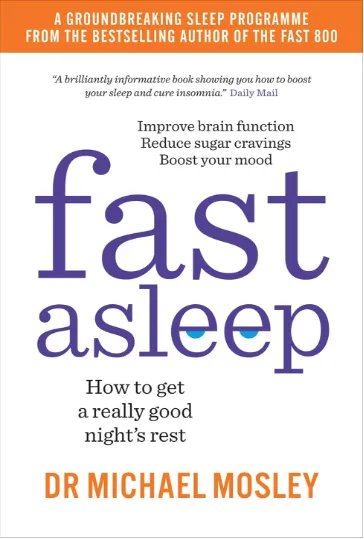
Fast Asleep: How to get a really good night's rest by Dr Michael Mosley
A good night's sleep is essential for a healthy brain and body. So why do so many of us struggle to sleep well? In Fast Asleep, Dr Michael Mosley explains what happens when we sleep, what triggers common sleep problems and why standard advice rarely works.
Prone to insomnia, he has taken part in numerous sleep experiments and tested every remedy going. The result is a radical, four-week programme, based on the latest science, designed to help you re-establish a healthy sleep pattern in record time.
With plenty of surprising recommendations - including tips for teenagers, people working night shifts and those prone to jet lag - plus recipes which will boost your deep sleep by improving your gut microbiome, Fast Asleep provides the tools you need to sleep better, reduce stress and feel happier.
We’re not just about overcoming obstacles, we’re about transforming lives.
Book Recommendation
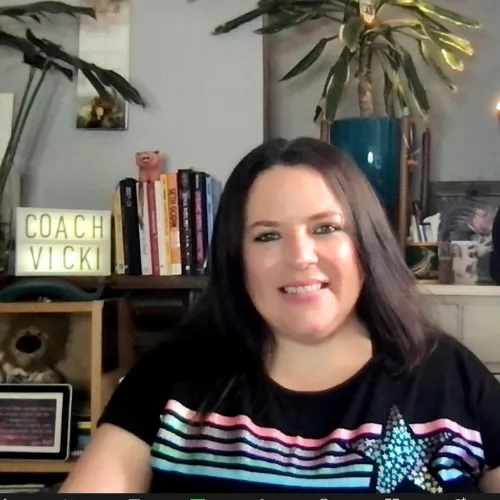
Victoria Canham - Performance and People Strategic Partner
Victoria Canham is an ICF-accredited Certified Professional Coach and the founder of Victoria Canham Consultancy. We are a specialist performance consultancy partnering with senior leaders and HR teams to elevate culture, leadership, and employee experience. Rooted in behavioural insight and change expertise, we diagnose what's truly holding performance back, co-creating practical, strategic interventions that drive sustainable business results and build workplaces that work—for people and performance.
Follow us on social media


💸 Your people don’t leave for money. 💣 They leave for culture. 🔧 I fix that. 🏆 Retention & performance strategy that works.
Book a ☎️ | Fix the Leaks


© Copyright 2026 Victoria Canham Coaching | Website built by Me on FEA Create (aff.)
Performance Coaching Reading, London, Berkshire, Oxford | St George's Road, Reading, Berkshire, United Kingdom, RG30 2RL | +44 7377 527 529 | [email protected] Open Monday to Friday 9 am until 5 pm