The Cost of Indecision Is Compounding. Stop Debating.
Victoria Canham • 29 July 2026 • 4 min read
The Culture Responsibility Leaders Have to Shoulder
Victoria Canham • 17 June 2026 • 4 min read
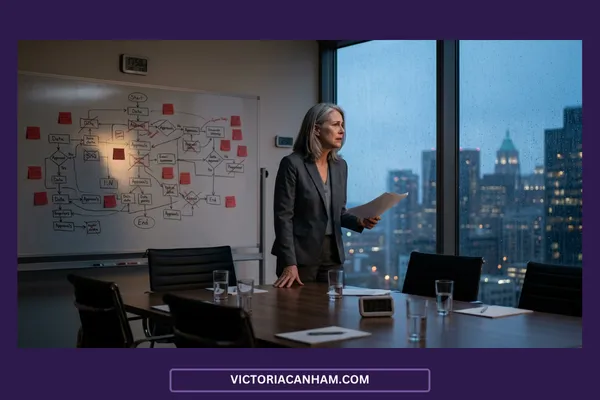
July Leadership Series · The People Strategy Reckoning. Part 5 of 5.
Every week a senior role stays vacant carries a measurable cost. Recruiter time, lost productivity, strategic decisions deferred, and the additional responsibility and stress placed on the people working around the gap. That cost compounds. It does not wait for the organisation to feel ready, and it does not pause while the leadership team debates whether now is the right moment to act.
For most organisations, the debate about whether to address a people strategy problem has itself become indistinguishable from the cost of not addressing it. Eventually, the conversation does not protect the organisation from a poor decision; it becomes the poor decision, spread across more meetings and dressed up as due diligence.
What Indecision Actually Looks Like in Practice
Indecision at the senior level is rarely described as fear or avoidance, because it arrives wearing the language of thoroughness. More data needed. More stakeholder input required. Another round of interviews to be certain. A working group formed to assess the options before anyone commits to a direction.
Each of these can be legitimate in isolation; collectively they describe an organisation that has lost confidence in its own judgement and is using process as a substitute for conviction. I call this management by democracy; it doesn’t work, it cannot work.
The clearest example of this, and one I will address directly because it deserves to be addressed, is the multi-stage interview process for roles that are not executive appointments.
If a non-executive senior role requires more than two interviews, that process is not demonstrating rigour. It is demonstrating that no single person at the top is prepared to take ownership of the decision. Five interview stages for a role below board level tells every candidate, and every employee watching the process internally, that the leadership team manages by consensus rather than leading with conviction. Each additional round is not extra assurance; it is another attempt to distribute the accountability for a decision that nobody at the top wants to own alone.
Candidates read this accurately, and the strongest ones draw the obvious conclusion. An organisation that cannot make a hiring decision without convening a committee is unlikely to make faster or cleaner decisions on other much bigger topics and strategies. Strong candidates with options factor that into their thinking. The ones who stay in a five-round process despite the signals are, increasingly, the ones with fewer alternatives.
The data on this is unambiguous.
A significant proportion of candidates withdraw from processes that drag, and the attrition is heaviest among the most experienced and most sought-after. A lengthy process does not protect the organisation from appointing the wrong person. It loses the right person while the organisation is still deciding whether it is ready to choose.
The Pattern Beneath the Process
Excessive process is not about thoroughness; it is about risk distribution. When a decision travels through five rounds and six stakeholders, no single person carries the full weight of having made the wrong call. The process becomes a mechanism for diffusing accountability rather than sharpening judgement, and the organisation mistakes the feeling of having been thorough for the outcome of having decided well.
This is the same instinct that produces strategy documents reviewed by twelve people before anyone will put their name to a recommendation, leadership team meetings that end without a clear owner for anything discussed, and senior decisions that travel sideways through informal consultation long after the formal process should have concluded.
It is understandable. It is also a direct signal to everyone within and outside the organisation that the leadership team does not trust its own judgement enough to act on it. Teams notice this. Candidates notice this. The cost of that signal extends well beyond the single vacancy currently sitting open.
What Decisive Leadership Actually Requires
This is not an argument for speed over care. It is an argument for ownership over diffusion.
A well-structured hiring decision at senior level requires one conversation to establish capability and one deeper conversation focused specifically on judgement and behaviour under pressure. It requires a decision made within days by someone with the authority and the conviction to make it, and a clear process for onboarding that person into the real culture of the organisation, rather than the aspirational version.
That is two interviews and a decision. Anything beyond that is the organisation asking for more reassurance than the process can actually provide.
Strong leadership teams are not distinguished by having perfect information before they decide. They are distinguished by the quality of their judgement and their willingness to stand behind it. The organisation that can hire well at pace, bring someone into a culture that matches what was described, and give them the conditions to succeed is not taking more risk than the organisation running five interview rounds. It is taking the same risk with considerably less waste.
The Thread Across This Entire Series
Across five pieces, the same pattern has run underneath every symptom examined. Bad senior hires that repeat themselves. Leadership assessments that produce confident, well-presented people who cannot lead under real pressure. A published and publicised culture that bears no resemblance to the one a new hire encounters by week three. Vacancies that keep reopening because the structural cause has never been identified. And an approach to decision-making that mistakes process for judgement and consensus for leadership.
These are not recruitment problems. They are leadership problems that have been blamed on the recruitment function, and they will keep recurring for as long as they are treated as the former rather than the latter.
The organisations addressing this effectively in 2026 are not the ones with the most sophisticated hiring tools or the longest interview processes. They are the ones with leadership teams prepared to examine what their culture actually produces, decide with conviction when the evidence is in front of them, and own the outcome rather than spread it across a committee.
The debate about whether your people strategy needs examining has already cost you more than the conversation would. If you have read this series and recognised your organisation in any part of it, the next step is straightforward. Book a confidential conversation with Victoria Canham and let's examine what is actually happening. The cost of waiting is not neutral. It is compounding.
This is the final part of a five-part series: The People Strategy Reckoning.
Read the other parts here:
Week 4: Every Open Senior Role Is a Confession
Week 3: Hire for the Culture You Actually Have
♦️ Hi, I'm Victoria Canham. I work with senior leaders, executives, founders and organisations when performance, pressure and people dynamics reach a point where the usual tools stop working.
My work sits at the intersection of leadership psychology, organisational performance and culture reality. I help executive teams navigate strained relationships, cultural brittleness, emotional fatigue, and the quiet erosion of trust that most businesses prefer not to acknowledge.
This isn't "feel-good" leadership development. It is measured, commercially grounded support that builds capability, deepens emotional resilience, and helps leaders operate with greater clarity, strength and humanity.
♦️ How I support organisations and senior leaders:
Executive Advisory
I work alongside CEOs and senior leaders as a trusted, discreet thinking partner. We deal with the real conversations, the emotional load of leadership, decision-making under pressure, and the personal dynamics that affect performance and culture.
Leadership Facilitation & Development
I design high-level development that respects intelligence, emotional reality and commercial context. These programmes help leaders communicate better, hold difficult conversations safely, and lead in a way that is firm, clear and credible.
Culture, Performance & Retention Support
I help organisations stabilise culture and strengthen psychological safety in ways that shift behaviour and engagement — not just look impressive on a slide deck.
If your leadership team is under strain, if relationships feel tense, or if the culture is becoming brittle, it may be time for a different conversation.
Book a confidential call to talk openly, think clearly and work out what your organisation really needs. No theatrics. No fluffy platitudes. Just honest, expert partnership.
Follow me on LinkedIn for human, psychologically intelligent leadership that actually works in the real world.

Comment On This Article
Recommended Reading
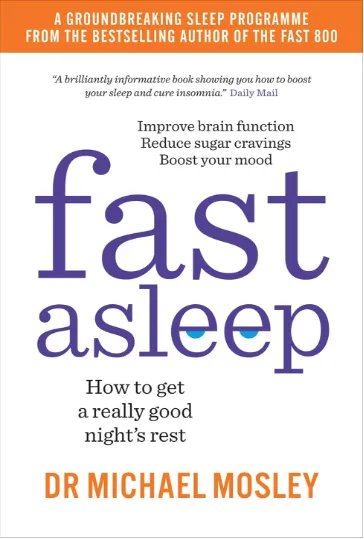
Fast Asleep: How to get a really good night's rest by Dr Michael Mosley
A good night's sleep is essential for a healthy brain and body. So why do so many of us struggle to sleep well? In Fast Asleep, Dr Michael Mosley explains what happens when we sleep, what triggers common sleep problems and why standard advice rarely works.
Prone to insomnia, he has taken part in numerous sleep experiments and tested every remedy going. The result is a radical, four-week programme, based on the latest science, designed to help you re-establish a healthy sleep pattern in record time.
With plenty of surprising recommendations - including tips for teenagers, people working night shifts and those prone to jet lag - plus recipes which will boost your deep sleep by improving your gut microbiome, Fast Asleep provides the tools you need to sleep better, reduce stress and feel happier.
We’re not just about overcoming obstacles, we’re about transforming lives.
Book Recommendation
Victoria Canham - Performance and People Strategic Consultant
Victoria Canham works with executive leaders and organisations when performance, culture and emotional pressure collide.
She is a Change Leader with over 25 years of experience, an ICF-accredited Professional Coach and founder of Victoria Canham Consultancy. Her practice focuses on strengthening leadership capability and organisational performance in the real world, not just on paper.
With twenty-five years in talent development, behavioural insight and large-scale change, she supports senior leaders navigating strained relationships, brittle cultures and high-pressure decision-making. Her work helps leadership teams stabilise, rebuild trust and operate with greater clarity and authority.
She is brought in when organisations cannot safely hold difficult conversations internally—when executive teams have stopped saying what needs saying, when founders need to step back, when high-performing individuals are costing more than they deliver. She creates the conditions where those conversations can actually happen, and where organisations can move forward from them.
The result is leadership that functions under pressure, cultures that hold up in practice, and teams equipped to perform sustainably.
Follow us on social media


💸 Your people don’t leave for money. 💣 They leave for culture. 🔧 I fix that. 🏆 Retention & performance strategy that works.
Book a ☎️ | Fix the Leaks


© Copyright 2026 Victoria Canham Coaching | Website built by Me on FEA Create (aff.)
Performance Coaching Reading, London, Berkshire, Oxford | St George's Road, Reading, Berkshire, United Kingdom, RG30 2RL | +44 7377 527 529 | [email protected] Open Monday to Friday 9 am until 5 pm